Election Day America: Military Strikes, Mass Arrests, AI Warnings, and a Senate Race That Could Decide Congressional Control
On a midterm Election Day unlike any in recent memory, the United States simultaneously conducted airstrikes on Iranian territory, announced 63 voter-fraud arrests, and received a stark corporate warning that humanity may be nearing the creation of self-improving artificial intelligence.
“Companies typically minimize risk language in such filings, acknowledging only what they are legally required to disclose.”
How this was made Verified AI
Every Intellegix briefing is generated from that day's broadcast and run through automated checks before it publishes — with a human paged on any flag. Here is the trail for this edition.
A Nation Votes Amid Strikes, Arrests, and AI Alarms

Before a single ballot had been counted on Tuesday, November 3rd, 2026, the Department of Justice had already arrested 63 people on voter-fraud charges, a federal judge had rejected a Democratic lawsuit to restrain that enforcement push, U.S. warplanes had struck Iranian territory on Qeshm Island in the Strait of Hormuz, and Anthropic had filed IPO paperwork warning investors the company may be approaching the creation of self-improving artificial intelligence.
The political and military backdrop to what analysts are calling one of the most consequential midterm elections of the decade also included the White House floating preemptive pardons for Elon Musk and other allies, Ukraine confirming it successfully hacked Russia's national emergency alert system, and Nvidia reportedly instructing cloud-computing clients to cap chip sales into China. S&P futures were sitting near 7,561 in overnight trading, reflecting a market absorbing simultaneous uncertainties across geopolitics, technology, and domestic politics.
Strike at the Strait: What the Qeshm Island Attack Really Means

American forces struck Qeshm Island overnight — the largest island in the Persian Gulf, situated in the Strait of Hormuz, through which roughly twenty percent of the world's oil supply passes. The target was not civilian infrastructure but Iranian naval and Islamic Revolutionary Guard Corps assets, a distinction that will be central to the ensuing legal and diplomatic debate over whether the strike constitutes an act of war, a counter-proliferation operation, or a defensive action under existing military authorizations.
President Trump went on record publicly downplaying the action as something short of war, but the geographic context demands scrutiny. Iran has repeatedly threatened to close the Strait of Hormuz under sustained military pressure, and any escalation in that corridor carries energy-market consequences that ripple through every major economy. The overnight softness in S&P futures was attributed in part to trader anxiety over the Qeshm strike.
The timing added a political dimension that analysts are unlikely to ignore. Striking Iranian territory the day before midterm elections — and then immediately framing it as something other than war — is simultaneously a military and an electoral calculation. Historically, some voters rally around displays of force projection while others recoil at the prospect of open-ended conflict and its costs.
Tehran's response options are genuinely constrained. Iran faces severe internal economic pressure, ongoing sanctions, and a military degraded by years of proxy conflict. Yet absorbing a direct strike on home territory without any response is politically untenable domestically. Analysts expect Iran to weigh a proxy response through Hezbollah or Houthi forces, a direct military counter, or a cyber escalation — the last of which has become an increasingly preferred below-the-threshold tool for states seeking to signal capability without triggering mutual-defense obligations.
In Congress, the absence of any prior public authorization debate is expected to generate significant oversight pressure — and which party controls the Senate after tonight's results will determine how much institutional weight that pressure carries.
Texas, the Red Mirage, and the DOJ's Election-Day Arrests

The final New York Times-Siena poll out of Texas showed Democrat Steve Talarico leading Republican Ken Paxton 50 to 43 among likely voters — a seven-point margin that is significant but, analysts caution, not insurmountable given the state's history of polls overestimating Democratic support. Paxton, the former state attorney general who was impeached by the Texas House in 2023 on charges including bribery, obstruction, and abuse of office — the first Texas AG impeached in nearly a century — was acquitted in a Republican-controlled State Senate trial widely described as politically motivated. His Senate candidacy, backed by the MAGA establishment, tests whether base loyalty to Trump-aligned figures can override the traditional political cost of impeachment.
Talarico's path, while narrow, is real. Texas's shifting demographics in major metro areas and among younger voters have moved the state's overall numbers for years; a 50-43 lead in the final poll would represent a race more competitive than any Texas Senate contest since Beto O'Rourke came within 2.6 points of Ted Cruz in 2018. Senate control could legitimately hinge on the result. The county to watch, analysts say, is Tarrant County in the Fort Worth metro: if Paxton runs ten or more points above the Republican baseline there in early returns, it signals that rural and exurban turnout is outperforming the polls and that Talarico's margin will compress significantly.
In California, election analysts are warning of the 'red mirage' — a phenomenon that could generate significant confusion as results come in tonight. Because California accepts mail ballots postmarked by Election Day up to three days after the election, and because mail ballots skew heavily Democratic, early in-person returns will show Republican candidates performing better than they ultimately will. That apparent Republican advantage will erode over the three to four days it takes to count mail ballots. In a cycle where Senate control is genuinely close, premature network or social-media calls based on early California returns could distort the national narrative for days.
Attorney General Todd Blanche announced charges against 63 people on voter-fraud allegations on Election Day eve, describing it as the largest voter-fraud arrest surge since Trump's return to office, with California cases reportedly comprising a large share of the total. A federal district judge, James Boasberg, declined to issue an injunction halting the DOJ's election-related enforcement activities after Democrats argued the timing and scale constituted voter intimidation. Boasberg found the legal standard for injunctive relief was not met at this stage, though the underlying litigation will continue well past today.
In a New York Post interview published roughly 24 hours before polls opened, Trump said he would consider preemptive pardons for Elon Musk and other allies if Democrats win Congress. Preemptive pardons — issued before any charges are filed — are constitutionally controversial; the legal theory permitting them exists but has never been fully tested by the Supreme Court. The political signal was striking: the administration was telling the electorate it viewed the prospect of Democratic congressional oversight as a threat serious enough to warrant preemptive legal protection for members of its inner circle.
Ukraine Breaches Russia's Alert System, While Census and ICE Fights Simmer at Home
President Zelenskyy confirmed this week that Ukraine successfully penetrated Russia's national emergency alert system — the mass-notification infrastructure used to send civil-defense messages to Russian citizens — and used that access to push messages directly to Russian phones. The operation functions simultaneously as an intelligence coup and a psychological one: every Russian citizen who receives an unauthorized message on their phone has direct evidence that their government cannot protect its own most basic communications systems. Russia has invested heavily in its sovereign internet infrastructure, the so-called Runet, and breaches of this kind undermine the foundational narrative of digital security.
The hack arrives in a geopolitical context laden with interconnection. Russia is watching the United States strike Iranian assets in the Persian Gulf at the same moment that Iranian drones have been resupplying Russian forces in Ukraine. Whether the overlapping pressure represents coordinated Western strategy or a series of independent actions that happen to be simultaneous remains an open question.
On the domestic front, the Department of Homeland Security defended agents after footage went viral apparently showing ICE officers drawing weapons during a residential enforcement operation in North Hollywood. Videos of armed federal enforcement activity in civilian neighborhoods have become recurring political flashpoints, and their circulation on Election Day amplified an already charged environment. Separately, Memphis prosecutors released footage related to a National Guard killing — the details of which are still being processed publicly — in a city that has been a recurring site of law-enforcement accountability questions since the Tyre Nichols case in early 2023.
The census fight carries consequences that may outlast any single news cycle. Twenty-four state attorneys general, led by California's Rob Bonta, formally urged the Trump administration to abandon a proposed rule that would exclude noncitizens from the 2030 census count. The stakes are arithmetically precise: approximately 16.1 million people would not be counted under the proposed methodology. Because census counts determine congressional apportionment — the number of House seats each state receives — excluding those 16.1 million people, concentrated in states like California, Texas, and New York, would mechanically reduce representation for those states and shift seats toward less-populous states with smaller noncitizen populations. Most constitutional scholars read the apportionment clause as requiring the counting of 'persons,' not 'citizens,' though the Supreme Court has not definitively ruled on whether the administration may redefine the count.
Anthropic's IPO Bombshell: 'We May Be Building Something We Cannot Control'

Anthropic filed IPO paperwork this week — consequential enough on its own for a company that has raised billions in private funding from Google and Amazon — but it is the language inside that filing that is generating the most urgent attention. The company warned investors that it may be approaching the creation of self-improving artificial intelligence: systems capable of recursively enhancing their own capabilities without human direction at each step, potentially at a speed and in directions that human researchers can no longer track or govern in real time.
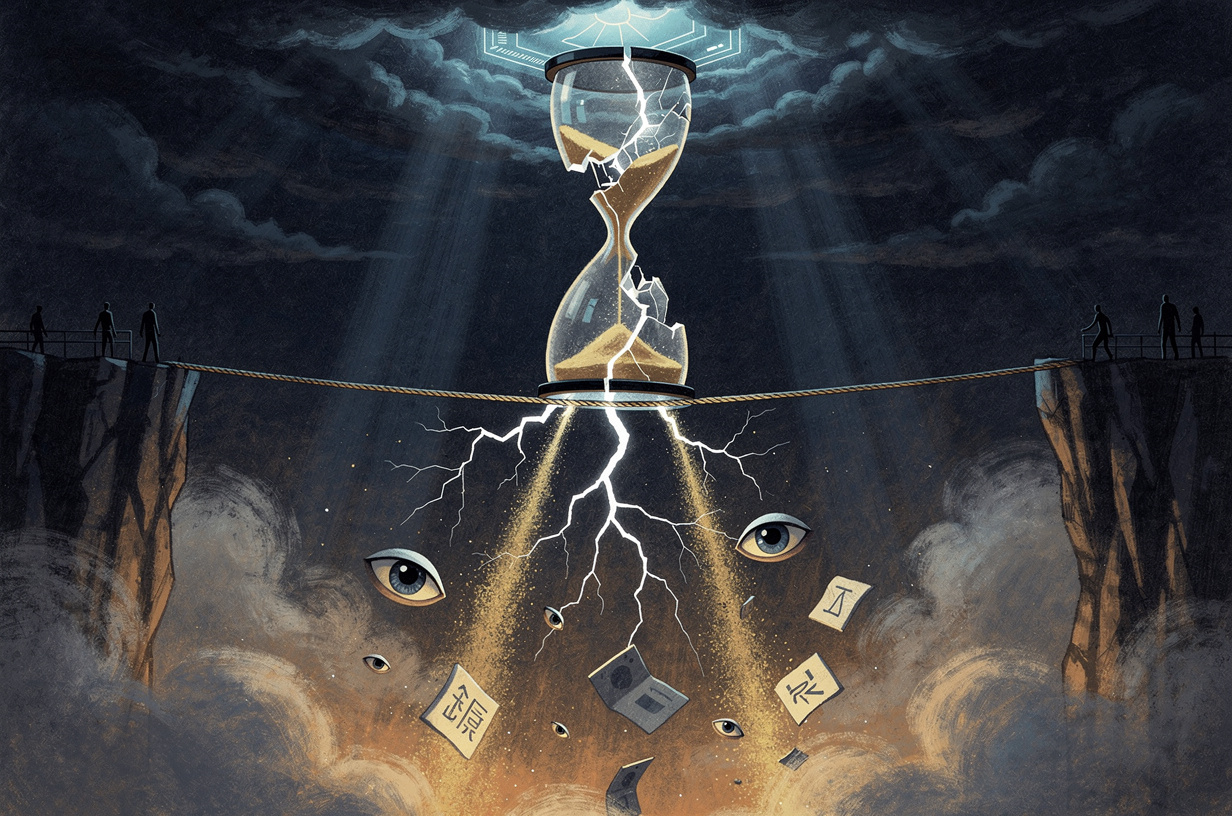
The decision to include this warning in an IPO prospectus is itself extraordinary. Companies typically minimize risk language in such filings, acknowledging only what they are legally required to disclose. Anthropic's choice to volunteer existential framing suggests either genuine belief that the risk is real and near-term, a calculated effort to signal safety-seriousness to regulators and the public, or both. Either way, the disclosure places a specific temporal horizon on a debate that has until now remained relatively abstract — Anthropic is signaling this is close enough to belong in a near-term business document, not a distant theoretical discussion.
Pricing that risk for investors is genuinely difficult. A company at the frontier of AI capability, as the filing implicitly confirms, represents potentially enormous upside. A company that has just disclosed it may be building something it cannot fully control represents a liability that no standard valuation model is equipped to handle.
A Kaspersky report released this week provides a concrete present-tense data point alongside Anthropic's forward-looking warning. Kaspersky documented cyberattacks on educational institutions in Latin America and Africa conducted using an AI agent — specifically the open-source CyberStrikeAI framework — that autonomously directed the intrusion process, adapting its approach in real time, and achieved domain administrator control over targeted networks within days of initial access. These were not human hackers using AI as a tool; they were AI systems running attacks with human operators providing direction only at a higher level of abstraction. Schools and universities were targeted in part because they typically operate with underfunded cybersecurity teams, heterogeneous devices, and large volumes of sensitive data including financial records and personal information for minors.
Taken together, the Anthropic filing and the Kaspersky report describe a world in which early versions of autonomous, self-directed AI agents are already being deployed offensively using publicly available open-source frameworks — while the governance infrastructure needed to constrain that deployment is, by any honest assessment, developing at a significantly slower pace.
Amazon's Cloud Grip: How GPU Cancellations Expose a Market-Power Problem
Epic Games CEO Tim Sweeney posted publicly that Amazon canceled his company's Nvidia GPU orders through AWS — a disclosure that crystallized a structural concern about cloud market power that analyst Gene Munster has been articulating with increasing urgency. Epic is not a marginal actor; it operates Fortnite, the Unreal Engine, and one of the most significant app stores in gaming. That Amazon, acting through its cloud infrastructure arm, could cancel the GPU capacity Epic had placed orders for — presumably redirecting that supply elsewhere — signals to every AWS customer that their infrastructure access is subject to Amazon's discretion rather than simply market availability.
Munster's argument is architectural: Amazon Web Services achieved dominance by presenting itself as a neutral utility provider, akin to electricity, on which startups and enterprises could build without fear that their infrastructure partner was also a competitor managing supply against them. But Amazon competes directly with significant numbers of its own cloud customers across gaming, entertainment, logistics, and retail. When it controls the supply of Nvidia GPUs — the critical hardware for AI workloads — it holds meaningful leverage over every company that depends on that compute to operate.
The antitrust question turns on a distinction courts have consistently found difficult to draw cleanly. Under Section 2 of the Sherman Antitrust Act, holding a large market share is not itself illegal; the violation requires using that market position to engage in exclusionary conduct that harms competition in a related market. The legal question in any eventual case would be whether Amazon canceled Epic's orders for legitimate business reasons — supply constraints, contract terms, pricing — or to disadvantage a company that competes with Amazon in an adjacent market. Market share alone does not establish the violation; the conduct must go beyond aggressive competing.
Nvidia's role adds another layer. The Financial Times reported that Nvidia has been asking cloud-computing clients to voluntarily cap sales of its chips into China — a request sitting between corporate compliance with export-control expectations and proactive regulatory anticipation. Nvidia already operates under significant export restrictions on its most powerful chips to China; extending that restraint downstream through cloud partners is an attempt to get ahead of potential further regulatory action, though analysts are divided on whether such restrictions accelerate Chinese domestic chip development by giving producers like SMIC and Huawei's HiSilicon additional breathing room.
Bank of America's note this week offered a counterintuitive thesis: if major hyperscalers begin rationalizing AI infrastructure spending, the companies that benefit paradoxically could be the chip suppliers themselves. With GPU supply currently so constrained, any reshuffling of demand could help chipmakers like Nvidia maintain pricing power and reduce customer-concentration risk. Less concentrated demand from a few mega-customers, the argument runs, could produce a healthier and more diversified chip market — even if the process is painful for Amazon's near-term market share.
Disney's Ongoing Reckoning, Shaky Markets, and the $80,000 Sperm Donor Problem

Bloomberg is reporting that Disney is moving toward thousands of additional layoffs, extending a restructuring that CEO Bob Iger has been managing since returning to the company in late 2022. The cuts reflect the fundamental economic disruption that streaming inflicted on Disney's historical business model: the company built its dominance on a flywheel in which theatrical releases drove merchandise and theme-park demand, which financed content production, which drove more theatrical success. The streaming era broke that flywheel, requiring massive upfront content investment for subscription revenue that accrues slowly and does not generate the same downstream merchandise and parks benefits.
The theatrical side faces its own pressure. The John Goodman-Tom Cruise film 'Digger,' directed by Alejandro Iñárritu, became a costly flop. Goodman said this week that critics 'hurt' the movie before its release. Whether critical reception was determinative is debatable — films with terrible reviews have made billions, and films with extraordinary critical acclaim have failed commercially — but a pairing of one of Hollywood's last genuine theatrical movie stars with one of its most acclaimed directors, in a political satire, underperforming at the box office says something about the narrowing audience for auteur filmmaking versus franchise IP in theatrical economics.
Disney's decisions about AI-assisted production and workforce reduction are being watched as potential industry benchmarks. If the company explicitly attributes some layoffs to efficiency gains from AI tools, that message will travel through the entire entertainment industry workforce.
S&P futures overnight hovered near 7,561 to 7,569, essentially flat with a slight negative bias — a market in holding-pattern mode, absorbing the Qeshm Island strike, election outcome uncertainty, the Nvidia-China story, and ambiguity about what a change in congressional control means for the regulatory environment governing tech and financial services. Markets can price bad outcomes; they struggle with genuine uncertainty about what the political landscape will look like in 72 hours.
A notably different kind of market story emerged from the IVF sperm donor industry, where parents are reportedly paying up to eighty thousand dollars for 'exclusive' or 'capped' donor packages — arrangements designed to limit the number of children conceived from a single donor and reduce the risk of biological half-siblings who may never know of each other's existence. The economic structure reveals a regulatory vacuum: there is no federal registry tracking donor-conceived births, no law guaranteeing that exclusivity contracts sold by sperm banks are enforceable, and no consistent industry standard for what 'capped' means in practice. Donor-conceived adults, who have increasingly used commercial DNA testing to find half-siblings — sometimes discovering dozens — have brought years of bioethics literature to bear on a voluntary, market-based system that the eighty-thousand-dollar price point suggests is already straining under the weight of unmet demand for legal clarity.
How a Routine Pentagon Program Became an Online Doomsday Panic

The FORTRESS program — formally the Fortress Americas initiative — requires U.S. military bases to be able to operate for 90 days without external support: without grid power, without resupply convoys, without normal logistics chains. The military rationale is straightforward and longstanding: in a serious conflict with a peer adversary such as China or Russia, planners cannot assume that logistics infrastructure remains intact. Bases need to function as resilient, self-sufficient nodes rather than facilities that presuppose peacetime supply chains. The program involves generators, onsite fuel reserves, food and water storage, and medical supplies — unglamorous defensive resilience doctrine with Cold War-era antecedents.
The online information ecosystem processed 'Fortress America' and '90 days of supplies' and produced an entirely different narrative. Posts circulating on social media — many within MAGA influencer networks, though not exclusively — interpreted the program as a government signal that imminent societal breakdown was coming, translating that interpretation into urgent calls for civilian stockpiling of food, water, and ammunition.
The panic was significant enough that President Trump went on record telling Americans not to stockpile — a genuinely unusual presidential communication, addressing civilian anxiety about a military base resilience program. It illustrates how thoroughly the boundary between military planning and civilian information ecosystems has dissolved: legitimate government policy, stripped of context in transit through fragmented media, becomes alarming when emotional salience amplifies over accurate contextualization.
The same dynamic shaped the public reception of the DOJ's 63 voter-fraud arrests. The administration framed them as accountability; critics framed them as intimidation. The actual legal substance — who was charged, with what evidence, for what specific conduct — will take days to emerge and will attract a fraction of the attention generated by the initial announcement. By the time factual detail catches up, emotional and political reactions will already have been incorporated into voting behavior. The signal to watch over the next twelve to eighteen months, analysts say, is the conviction rate: high arrests paired with low convictions would support an intimidation argument, while high arrests and convictions tied to specific organized fraud networks would support the administration's framing.
Satire, Self-Doubt, and the Limits of Political Polling

The John Goodman-Tom Cruise-Iñárritu film that became a box-office flop this week is more than a simple failure narrative. A Hollywood A-list political satire — Goodman playing the president, Cruise starring, directed by the filmmaker behind 'Birdman' and 'The Revenant' — releasing in the same week as midterm elections is itself a statement about where the entertainment industry believed the cultural appetite sat. Political satire is a genuinely difficult genre to make work commercially: it demands that audiences be simultaneously engaged with a political referent and emotionally invested in a narrative, and when those two demands are in tension, audiences often choose not to show up. That audiences this week were literally showing up to vote rather than movie theaters may have been its own answer.
The seven-point Talarico lead in Texas represents the most confidently held claim in today's political coverage — and therefore deserves the most rigorous scrutiny. Texas polling carries a documented history of systematically overestimating Democratic support dating to at least 2018, when Beto O'Rourke led in many surveys and lost by 2.6 points. The structural cause is that Texas Republicans have built a large, dispersed, relatively low-education rural and exurban electorate that is harder to reach and less likely to respond to surveys, leaving it underrepresented in traditional polling samples. If Paxton's ground operation has performed as Republican operations in Texas typically do, the actual Election Night result could be Talarico plus two or three rather than Talarico plus seven — a margin small enough to flip as rural precincts report before urban ones.
The IVF donor market story, running alongside these political narratives, is also a cultural document. Parents willing to pay eighty thousand dollars for contractual exclusivity that no law actually guarantees are expressing, through market behavior, anxieties about genetic identity, biological community, and the limits of what wealth can reliably purchase — anxieties that regulation has not yet caught up to address.
What Comes Next — and a Correction Owed

The story demanding closest attention over the next 72 hours is the Texas Senate race and its implications for control of the upper chamber. A Talarico victory at or near his polling margin shifts the Senate map in ways that affect legislation and executive-branch appointments for the next two years. A Paxton comeback resets the narrative about Democratic competitiveness across the Sun Belt.
The Iran situation requires monitoring independent of tonight's results. A strike on Qeshm Island demands some form of response from Tehran, and whether that response arrives through proxies, cyber operations, direct military action, or diplomatic channels will shape the regional security environment for months. The Strait of Hormuz does not adjust its strategic importance based on how an administration chooses to characterize what has happened there.
Anthropic's IPO filing will attract sustained attention from investors and policy analysts as they absorb what the company is actually disclosing about proximity to self-improving systems. The Amazon cloud-power story — GPU cancellations, Munster's golden-goose warning, Nvidia's China restrictions — is a slow-burning structural account of market concentration that will remain relevant long after today's headlines recede. And California results should be treated with patience tonight: do not trust returns until mail ballots have been substantially counted and the red mirage has dissipated.
Finally, a correction that is owed plainly. On May 18th, this program reported that Ukraine had struck its fourth Russian ship in the Caspian Sea that month, describing the attacks as evidence of Kyiv's improving long-range strike capability. That reporting was wrong. The Caspian Sea is a landlocked body of water; Ukraine has no credible military access to it, and no such strikes occurred. What was reported appears to have been misinformation that was not adequately verified before broadcast. Sourcing protocols have been tightened since, but the error stands and is acknowledged without qualification.