The Great Spirit and the Sacred Hoop: Indigenous Religious Traditions of North America
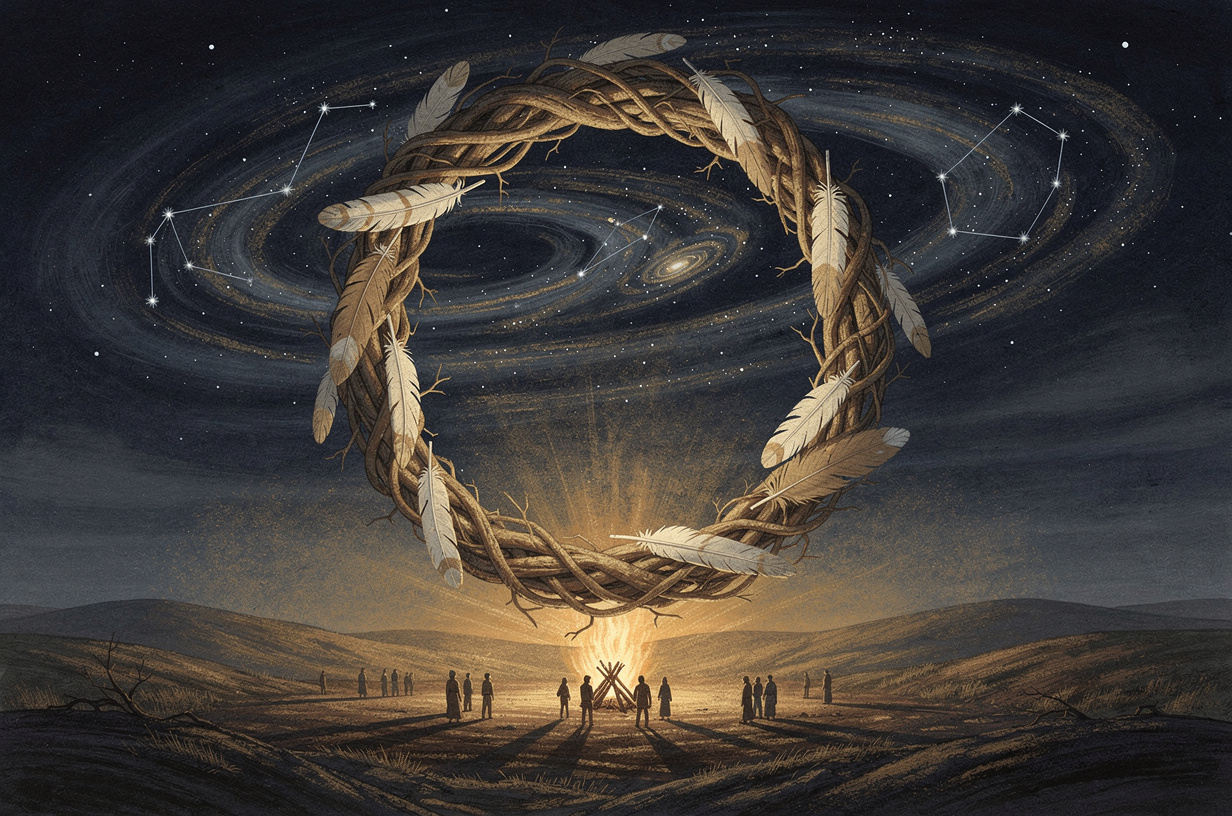
Long before European contact, the Indigenous peoples of North America developed rich and diverse spiritual traditions rooted in a deep relationship with the land, community, and the cosmos. This episode explores common threads across many traditions — including concepts of the Great Spirit, the sacred hoop of life, animism, and ritual ceremony — while honoring the profound diversity among hundreds of distinct nations and cultures. We also touch on the ongoing work of preservation, revitalization, and the importance of approaching these living traditions with respect and humility.
How this was made Verified AI
Every Intellegix briefing is generated from that day's broadcast and run through automated checks before it publishes — with a human paged on any flag. Here is the trail for this edition.
The Great Spirit and the Sacred Hoop: Indigenous Religious Traditions of North America
From Intellegix, this is Intellegix World Religions — an educational look at the world's religions. This show neither endorses nor rejects any belief.
Today we're going to spend time with something genuinely vast — a subject so wide and deep that an entire library of books couldn't fully contain it, let alone a single podcast episode. And that's important to say right at the outset, not as a disclaimer designed to lower expectations, but as a genuine truth about our topic. We're talking about the Indigenous religious and spiritual traditions of North America — a subject that encompasses hundreds of distinct nations, thousands of years of living practice, dozens of language families, and an almost incomprehensible range of ceremonies, cosmologies, sacred relationships, and ways of understanding what it means to be alive on this earth.
By the end of this episode, you'll have a clearer understanding of some of the most commonly discussed concepts that scholars and adherents use to describe these traditions — ideas like the Great Spirit, the sacred hoop, animism, and ceremonial reciprocity. You'll also come away with a deeper appreciation for why treating these traditions as a single unified religion would be a profound mistake, and why that diversity is itself one of the most important things to understand. And you'll understand something about the ongoing vitality of these traditions today — the challenges they face, the work of revitalization, and the continuing spiritual lives of millions of people for whom these are not ancient curiosities but living, breathing, deeply personal ways of relating to the world.
Let's begin at the beginning — or rather, let's begin with the question of beginnings, because that question itself reveals something important.
When Western scholars first attempted to study and categorize Indigenous North American religions in the eighteenth and nineteenth centuries, they tended to approach the task through the same framework they used to study other world religions. They looked for founding figures, for sacred texts, for systematic theology, for a definable historical moment of origin. And by those measures, Indigenous traditions seemed, to those early observers, frustratingly elusive. There was no single prophet, no founding date, no canonical scripture in the familiar written sense. What those scholars missed — and what later researchers and, more crucially, Indigenous scholars themselves have been careful to articulate — is that the absence of those features isn't a deficiency. It reflects a fundamentally different understanding of what religion is and how it lives in the world.
The spiritual traditions of Indigenous North American peoples developed over extraordinary stretches of time. Archaeological evidence and oral traditions both point toward human presence in the Americas stretching back at least fifteen thousand years, and by some scholarly accounts potentially much longer, though debates about the precise timing of the first migrations continue. What isn't debated is the depth and sophistication of what developed across that time. Across the continent — from the Arctic coasts of what is now Alaska and northern Canada, to the forests of the Pacific Northwest, the Great Plains, the Sonoran Desert, the river valleys of the Southeast, and the woodlands of the Northeast — distinct peoples developed distinct ways of understanding their relationship with the land, with other living beings, with the cosmos, and with the unseen forces that many traditions regard as underlying and animating all of existence.
Each of these traditions emerged from and stayed deeply connected to specific places. This is one of the first things that Indigenous scholars and practitioners consistently emphasize when speaking to outsiders about their spirituality: these are not abstract universal religions that could in principle be practiced anywhere. They are rooted in particular landscapes, particular bodies of water, particular sacred sites, particular seasonal cycles, particular animals and plants and weather patterns. The Lakota relationship with Paha Sapa — what non-Indigenous Americans call the Black Hills — is not merely a sentimental attachment to a pretty landscape. In Lakota spiritual understanding, that land is sacred in a specific, irreplaceable, non-negotiable way. The same could be said for the Haudenosaunee relationship with the Great Lakes region, or the Diné relationship with the landscape of the Four Corners, or the Tlingit relationship with the coastal waters and forests of the Pacific Northwest.
This rootedness in place also means that these traditions evolved in dialogue with their specific ecological contexts. Peoples whose primary subsistence came from salmon developed spiritual practices deeply interwoven with the salmon's life cycle. Peoples of the Great Plains developed spiritual relationships with the bison that went far beyond economic utility. Desert peoples developed intricate ceremonial relationships with rain, with drought, with the precise timing of planting cycles. None of this was mere superstition or primitive science. Scholars of religion increasingly understand these practices as sophisticated systems of knowledge about the natural world, encoded in ceremonial form and transmitted across generations through oral tradition, artistic practice, and lived ritual.
That brings us to one of the most important and also most commonly misunderstood concepts associated with Indigenous North American spirituality: the question of the Great Spirit. You've likely encountered this term — it appears frequently in popular culture, in historical accounts, in the rhetoric of certain pan-Indian political movements, and in the writings of non-Indigenous observers going back several centuries. But what does it actually mean, and does it mean the same thing across different traditions?
The short answer, which scholars consistently emphasize, is no — it does not mean exactly the same thing across traditions, and the term itself requires careful handling. The concept of a supreme, overarching spiritual force or being does appear in many Indigenous North American traditions, but its nature, its attributes, and its relationship to other spiritual beings and forces varies enormously. Among the Lakota and other Sioux-speaking peoples, the concept often described to outsiders as the Great Spirit carries the Lakota name Wakan Tanka. This term is sometimes translated as Great Spirit, sometimes as Great Mystery, and sometimes simply as the Sacred. Lakota practitioners and scholars have been careful to note that Wakan Tanka is not straightforwardly equivalent to the monotheistic God of Christianity or Islam. Wakan Tanka is better understood as a kind of overarching sacred power or presence that encompasses all of existence, including but not limited to a range of more specific spiritual beings and forces called wakan — meaning sacred or mysterious — that operate throughout the world.
Among the Anishinaabe peoples — sometimes called Ojibwe or Chippewa — a similar but distinct concept exists in the figure of Gitche Manitou, sometimes translated as Great Spirit or Great Mystery. Again, this exists within a rich cosmological context that includes a wide range of other spiritual beings and forces. For the Haudenosaunee — the Six Nations of the Iroquois Confederacy — the spiritual landscape is shaped by a different set of foundational beings and stories, including the Creator often called in English the Great Spirit, but also the Good Twin and Evil Twin, Sky Woman, the Three Sisters, and a host of other spiritual presences with specific roles and relationships.
When Europeans first encountered these concepts, many of them — particularly Christian missionaries — interpreted them through a theological lens that was comfortable and familiar to them. They heard "Great Spirit" and assumed they were hearing a version of God, and they concluded that Indigenous peoples were therefore monotheists who simply hadn't yet received the Christian revelation. This interpretation was self-serving, intellectually reductive, and in many cases led to serious distortions in how these traditions were recorded and transmitted to later audiences. Scholars today are careful to note that while certain surface-level similarities exist between Indigenous concepts of supreme spiritual power and monotheistic notions of God, the underlying structures and implications are quite different — and that those differences matter.
What does seem to be genuinely widespread across a large number of Indigenous North American traditions, however, is something that scholars of religion often describe using the term animism — though that term too requires some care. In its older usage, animism was sometimes deployed by anthropologists as a somewhat condescending label for what they considered a primitive stage of religious development, the idea being that "animistic" peoples naively attributed souls or spirits to natural objects. Contemporary scholars of religion, drawing heavily on the work of Indigenous thinkers and researchers, understand animism in a far more sophisticated way. The concept, as articulated by scholars like Graham Harvey, refers not to a naive confusion about whether rocks and trees are conscious, but to a relational understanding of the world — a way of perceiving all of reality as populated by persons, not all of whom are human, and of understanding life as constituted by relationships among those persons.
In this understanding, which resonates with the self-descriptions offered by many Indigenous practitioners across numerous traditions, the world is not divided into a living human realm and a passive, inert natural backdrop. Rather, the forest is alive — not metaphorically but in some meaningful, practical sense. The river has agency. The eagle is not merely a bird but a being with its own perspective, its own relationships, its own spiritual significance. The bear is not simply an animal but, in many traditions, a being with whom humans stand in particular kinds of relationships — relationships that carry obligations, that require acknowledgment, that demand a certain conduct.
This relational worldview is what underlies one of the most pervasive and important themes across Indigenous North American spiritual life: the idea of reciprocity. In tradition after tradition, across vastly different cultural contexts, we find the same fundamental principle — that living well in the world means maintaining right relationships with all the beings and forces one encounters, and that maintaining right relationships requires giving back, not only taking. When a hunter kills a deer, the killing is understood in many traditions as a kind of gift from the deer — and that gift requires acknowledgment, gratitude, and respect. The bones may be returned to the earth. Specific prayers may be offered. The animal may be spoken to, apologized to, thanked. This is not theater. Adherents understand these acts as genuinely necessary — as the fulfillment of obligations that make the ongoing relationship possible.
Robin Wall Kimmerer, a botanist who is also a member of the Citizen Potawatomi Nation, has written beautifully about this principle in her widely read book Braiding Sweetgrass, noting that in the Potawatomi understanding, the natural world constantly offers gifts to human beings, and that human flourishing depends on learning how to receive those gifts gratefully and how to offer gifts in return. This principle, she argues, stands in fundamental contrast to the extractive logic of industrial capitalism, which treats the natural world purely as a resource to be used. Whether one approaches this from a spiritual or a secular ecological perspective, the contrast is striking and instructive.
Another concept that appears widely across Indigenous North American traditions and has received considerable attention in popular discourse is often rendered in English as the Sacred Hoop, or the Circle of Life. The Lakota holy man Black Elk, in his famous account of his visions — recorded by the poet John Neihardt and published in 1932 as Black Elk Speaks — described the hoop as the fundamental shape of life: the shape of the world, of the sky, of the seasons, of the movements of stars, of the cycles of birth and death and renewal. In Black Elk's account, the destruction of the sacred hoop was intimately connected with the destruction of his people's way of life through colonization, and its restoration was the great hoped-for work of his people's spiritual future.
It is important to note, as scholars do, that Black Elk Speaks is a complex and contested document. It was filtered through translation, through Neihardt's editorial shaping, and through the specific moment of its composition — a moment of tremendous crisis and loss for the Lakota people. Later in his life, Black Elk, who had converted to Catholicism, expressed some ambivalence about the book and the way it had been received. His great-grandson, Damian Black Elk, has been among those who have offered more nuanced accounts of his ancestor's spiritual life. Nevertheless, the book remains one of the most widely read accounts of Lakota spirituality in existence, and the concept of the hoop or circle as a governing spiritual symbol does appear, in various forms, in many other Indigenous traditions beyond the Lakota.
The circle as a symbol of wholeness, continuity, and the interconnection of all things appears in Navajo sand paintings, in the circular form of many ceremonial lodges, in the medicine wheel concept found across Plains traditions, in the circular dances of many peoples, and in the cyclical structure of ceremonial calendars that govern spiritual life in communities from the Arctic to the Southwest. The precise meaning and significance of the circle differs from tradition to tradition, but the underlying intuition — that life is circular rather than linear, that endings are also beginnings, that all things are connected in a great web of relationship — is widely attested.
Now let's turn to the question of sacred texts and ceremonial practice, because this is where we encounter one of the most important structural differences between Indigenous North American traditions and many of the world's other major religious traditions. These are, overwhelmingly, oral traditions. Their sacred knowledge is transmitted not through written scripture but through story, song, ceremony, and the practical teaching of skilled practitioners to their apprentices and community members.
This does not mean that Indigenous traditions lack systematic knowledge or sophisticated theology. It means that knowledge lives differently — in human bodies, in lived relationships, in seasonal rhythms of ceremony, in the memory of elders, in the songs that must be sung at precisely the right moment in precisely the right way. Many Indigenous communities regard their oral traditions as strictly equivalent in authority and precision to what other cultures call scripture. The stories are not loosely told and constantly reinvented. Many are regarded as sacred truths that must be transmitted faithfully, often by specific people who have been designated and trained for that responsibility.
These oral traditions encompass creation stories, hero narratives, stories of the origins of ceremonies, accounts of the relationships between human beings and spiritual powers, teachings about how to live and how to die, and narratives that encode sophisticated ecological and cosmological knowledge. Among the Haudenosaunee, the Great Law of Peace — the Gayanashagowa — is an extensive oral constitution that governs both the political and spiritual life of the Confederacy. It describes in precise detail the structure of the League, the roles of clan mothers and chiefs, the processes of decision-making and conflict resolution, and the spiritual principles that underlie them. Scholars have noted that this tradition of oral governance and spiritual law shaped the thinking of some of the founders of the United States Constitution, though the precise extent of that influence is debated.
Among the Diné — the Navajo — the oral traditions include an extraordinarily complex creation narrative that describes the emergence of the People through a series of underworlds into the present world, the establishment of right relationships with Holy People, and the origins of the ceremonies that maintain those relationships. Navajo ceremonial practice includes the Blessing Way, the Enemy Way, the Night Chant, and dozens of other specific ceremonies, each of which involves specific songs, prayers, sand paintings, and ritual actions that must be performed with great precision. These ceremonies serve various functions — healing, blessing, restoring balance, marking transitions, addressing harm — and they are conducted by highly trained specialists, called Hataałii or singers, who may spend years learning a single ceremony.
This brings us to another concept that appears widely across Indigenous traditions in North America: the idea of healing not merely as a physical process but as a restoration of right relationship and balance. In many traditions, illness — whether physical, psychological, social, or spiritual — is understood as a sign that something has gone out of balance, that some relationship has been broken or some obligation unfulfilled. Healing ceremonies are therefore not simply medical procedures but complex spiritual interventions designed to restore the patient to right relationship with themselves, their community, the spirit world, and the land. This understanding of health as fundamentally relational and holistic has attracted considerable interest from contemporary scholars in the fields of medical anthropology and integrative medicine.
The role of specialized spiritual practitioners — often called medicine men or medicine women in popular parlance, though many communities have their own specific terms — varies enormously across traditions. In some communities, these practitioners are hereditary specialists who inherit their roles and the knowledge associated with them. In others, the calling comes through dreams or visions. The vision quest — a practice of deliberate solitary isolation, fasting, and prayer intended to open the practitioner to spiritual guidance — is widely attested across Plains and other traditions as a foundational method for establishing or deepening a relationship with spiritual powers. Young people in many communities historically undertook vision quests as part of coming-of-age practice, and many adults return to this practice at significant moments in their lives.
The sweat lodge ceremony — called Inipi in Lakota — is another practice found across a wide range of North American traditions, though its precise form and meaning differ. In general, it involves entering a small dome-shaped structure, pouring water over heated stones to create steam, praying, singing, and enduring an experience of intense heat that practitioners often describe as both physically purifying and spiritually transformative. It is understood in many traditions as a way of entering into intimate relationship with the elements — with fire, water, earth, and air — and of addressing the spiritual as well as the physical dimensions of whatever one brings to the ceremony.
Drumming, singing, and dance are central to ceremonial life across virtually all Indigenous North American traditions, though again the specific forms and meanings vary enormously. The drum is understood in many Plains and other traditions as representing the heartbeat of the Earth Mother, or as a vehicle through which spiritual communication becomes possible. Communal dancing — such as the ceremonial dances of Pueblo peoples, the sacred dances of Northwest Coast peoples during potlatch ceremonies, or the Sun Dance of the Plains — is rarely understood by participants as mere performance or entertainment. It is active spiritual work: the maintenance of relationships, the fulfillment of obligations, the renewal of the world.
The potlatch itself deserves special mention, because it illustrates beautifully how spiritual and social life are integrated in many Indigenous traditions in ways that resist easy categorization by Western standards. Practiced by numerous peoples of the Northwest Coast — including the Kwakwaka'wakw, the Haida, the Tlingit, the Tsimshian, and others — the potlatch is a ceremony in which a host family invites guests from other communities and distributes gifts on a lavish scale. To the outside observer trained in market economics, the potlatch looks like an economically irrational act. But within its own logic, which integrates spiritual, social, political, and economic dimensions, the potlatch is an act of profound significance: it establishes and reaffirms relationships, acknowledges the obligations that come with wealth and position, demonstrates connection with the spiritual powers that make abundance possible, and enacts the principle of reciprocity at a communal level. The Canadian and American governments, regarding the potlatch as wasteful and subversive of the economic values they wished to impose on Indigenous peoples, banned it in Canada from 1885 to 1951 — a fact that illustrates the depth of the colonial assault on Indigenous spiritual life.
Let us speak more directly about internal diversity, because it would be easy, even with the best intentions, to slip into treating Indigenous North American religions as more unified than they are. Scholars consistently emphasize that we are not dealing with a single religion but with a vast plurality of distinct religious traditions that share some broad family resemblances without forming a single coherent system. The differences are real and significant.
Consider the contrast between the spiritual worldviews of two neighboring but distinct peoples: the Hopi and the Diné of the American Southwest. Both peoples have deep roots in the region. Both have complex ceremonial traditions. Both understand the world in terms of relationships between human beings and spiritual powers. But their cosmologies, their origin stories, their ceremonies, and their understandings of proper conduct differ in important ways. The Hopi ceremonial calendar is organized around a cycle of Kachina — spiritual beings who descend from their mountain homes to dance in the villages during certain seasons and whose presence brings rain and renewal. The Diné tradition has a quite different cosmological architecture, organized around the Holy People, the concept of hózhó — roughly, beauty, balance, and harmony — and the specific ceremonial system of the Blessing Way and related rites.
Or consider the profound differences between the ceremonial traditions of Arctic peoples — like the Inuit and Yup'ik — and those of the peoples of the Southeast — like the Cherokee, the Muscogee, or the Choctaw. The Inuit relationship with the spiritual world has been shaped by an environment of extreme cold, darkness, ice, and ocean, and centers on relationships with animal spirits, the figure of the shaman or angakkuq, and complex taboo systems governing the treatment of hunted animals. The ceremonial traditions of the Southeast, shaped by a very different environment of forests, rivers, and agricultural abundance, center on the Green Corn Ceremony — a major annual rite of renewal, thanksgiving, and communal reconciliation — and on a rich tradition of sacred fire and ritual purification.
The diversity also extends to questions of gender and spiritual authority. In some traditions, women hold significant spiritual authority — as clan mothers among the Haudenosaunee, as medicine women in various communities, as carriers of essential ceremonial knowledge. In others, certain ceremonies are restricted to men. In still others, people who inhabit what Western observers have sometimes called a "third gender" — often referred to by the pan-Indian term two-spirit, though specific communities have their own terms — have historically occupied important spiritual roles. The phenomenon of what anthropologists have called the berdache and what many Indigenous communities now prefer to discuss on their own terms is complex, varied across cultures, and has been both romanticized and distorted in outside accounts. What seems clear from Indigenous scholarship is that many traditions have historically recognized gender diversity and that gender-diverse individuals have in many cases been seen as spiritually gifted precisely because of their ability to embody multiple perspectives.
Now we must speak honestly about the catastrophic disruption that colonization brought to these living traditions — because we cannot understand Indigenous religions in the present without understanding what happened in the past several centuries, and we cannot understand the contemporary situation without grappling with that history. The Spanish, French, Dutch, British, and later American and Canadian colonial projects all, in various ways and to varying degrees, attacked Indigenous religious practice. Missionary efforts — some coercive, some sincere, all operating within a framework that regarded Indigenous religion as inferior or dangerous — reshaped the spiritual landscapes of many communities. The boarding school systems that operated in both the United States and Canada from the late nineteenth century well into the twentieth deliberately removed Indigenous children from their communities and forbade them from speaking their languages or practicing their ceremonies. The slogan attributed to Captain Richard Henry Pratt, founder of the Carlisle Indian Industrial School — "kill the Indian, save the man" — captures with horrifying precision the spiritual and cultural violence that was deliberately intended.
The Ghost Dance — a religious movement that emerged in the late 1880s, centered on the teachings of a Paiute prophet named Wovoka — offers a painful illustration of the colonial suppression of Indigenous spiritual life. Wovoka's teachings, which spread rapidly across Plains communities, centered on ceremonial dancing that he taught would hasten the restoration of the old world, the return of the buffalo, and the renewal of Indigenous life. American authorities, alarmed by the movement, moved to suppress it. The result was the massacre at Wounded Knee in December 1890, in which approximately 250 to 300 Lakota men, women, and children were killed by US Army troops. It was not only a military atrocity but a spiritual one — an attack on people engaged in religious practice.
The American Indian Religious Freedom Act of 1978 was a significant legislative acknowledgment that the US government had systematically violated the religious rights of Indigenous peoples and an attempt to provide some protection for those rights going forward. But scholars and practitioners alike have noted that the act has significant limitations in practice — that sacred sites have continued to be threatened by development projects, that Indigenous religious objects and human remains held in museum collections have been slow to be repatriated despite the passage of the Native American Graves Protection and Repatriation Act in 1990, and that the broader conditions of poverty, political marginalization, and cultural disruption that undermine the transmission of traditional knowledge have not been adequately addressed.
At the same time, this story is not only a story of loss and destruction. It is equally a story of resilience, adaptation, and ongoing vitality. Indigenous communities across North America have preserved, revitalized, and actively practiced their spiritual traditions through periods of tremendous pressure. Languages have been kept alive by dedicated speakers and teachers. Ceremonies that were driven underground during periods of suppression have been brought back into the open. Young people in many communities are actively seeking to reconnect with the traditions of their ancestors. There is a flourishing body of Indigenous scholarship — by figures like Vine Deloria Jr., whose 1969 book Custer Died for Your Sins fundamentally challenged the way non-Indigenous scholars had approached Native American life, and whose 1973 book God Is Red offered a sustained comparison of Indigenous and Christian worldviews — that has transformed the academic study of these traditions by centering Indigenous voices and perspectives.
The work of revitalization is happening on many fronts. Language revitalization programs in communities from Hawaii — where the native Hawaiian tradition, though Pacific rather than North American, offers important parallel lessons — to the Mohawk communities of Kahnawà:ke are working to restore the linguistic foundations without which many ceremonies cannot properly function. Cultural camps where young people learn traditional skills, songs, stories, and practices alongside elders are operating in many communities. Tribal colleges and universities are developing curricula that integrate traditional knowledge with academic study. Indigenous artists, writers, filmmakers, and musicians are creating work that expresses and extends their spiritual and cultural traditions in contemporary form.
Contemporary scholars who study Indigenous North American religions face a set of methodological challenges that are worth reflecting on, because they illuminate something important about the nature of these traditions and about the history of their study. Early anthropologists and ethnographers — figures like Lewis Henry Morgan, Franz Boas, and James Mooney — collected enormous amounts of information about Indigenous ceremonies, beliefs, and practices, often with great diligence and some genuine respect, but almost always within a framework that positioned Indigenous peoples as subjects of study rather than producers of knowledge. Their work was shaped by evolutionary assumptions, by the belief that Indigenous traditions were remnants of humanity's primitive past rather than sophisticated living systems, and often by a desire to record what they assumed was vanishing before it disappeared entirely.
Contemporary scholars, particularly those working within the growing field of Native American and Indigenous Studies, approach the subject with very different assumptions. They take Indigenous accounts of Indigenous experience seriously as forms of knowledge rather than as data to be processed through outside theoretical frameworks. They acknowledge that some sacred knowledge is not appropriate for outside study or publication, and they respect the right of communities to determine what aspects of their traditions they wish to share with outsiders and what they wish to keep private. The Society for the Study of Indigenous Religions and the journal American Indian Religions, Historical and Philosophical Issues are among the academic venues where this more respectful and collaborative scholarship is being developed.
The question of who gets to speak about these traditions — and in what contexts — is one that communities themselves are increasingly taking charge of. Many Indigenous communities have developed protocols governing what can be shared publicly, what can be recorded, what can be photographed, and what must remain within the community. The now-famous closing of Uluru — Ayers Rock — in Australia's Northern Territory to tourist climbers in 2019 offers a parallel example of Indigenous communities asserting their right to protect the integrity of sacred sites. In North America, ongoing disputes over access to and protection of sacred sites — including Bears Ears in Utah, the Black Hills of South Dakota, the San Francisco Peaks in Arizona, sacred to Hopi and Diné peoples — continue to illustrate the very live tension between Indigenous spiritual claims and the interests of governments, extractive industries, and tourist economies.
There is also the complex and sometimes contentious issue of what scholars call the "New Age" appropriation of Indigenous spiritual concepts and practices — the widespread phenomenon of non-Indigenous people adopting fragments of Indigenous ceremony, adopting terms like "spirit animal" or "medicine wheel" in contexts far removed from their original meanings, and sometimes claiming authority to transmit Indigenous spiritual knowledge without the community accountability that legitimate transmission requires. Indigenous communities and scholars have generally been clear that this kind of appropriation — however well-intentioned individual participants may be — causes real harm. It distorts and trivializes sacred practices, it deprives communities of control over their own traditions, and it can create economic competition for the very people whose traditions are being borrowed from. This is a live and important debate, and it is one that any thoughtful engagement with Indigenous spiritual traditions must take seriously.
Where does all of this leave us as we come to the close of this episode? With what we might call a humble abundance — an awareness of how much is here, how much has been preserved against tremendous odds, and how much remains to be learned by those who approach these traditions with the right posture.
The spiritual traditions of Indigenous North America are not relics of the past. They are not romantic fantasies of life in harmony with nature, untouched by the complexities of history and human conflict. They are living systems of meaning and practice, embedded in specific communities and specific landscapes, shaped by thousands of years of accumulated wisdom and by the specific histories — including the history of colonialism — that each community has lived through. They include prayers and arguments, innovations and conservatisms, disputes and consensus, joy and grief and everything in between.
The common threads that we've traced through this episode — the relational understanding of the world sometimes called animism, the principle of reciprocity, the centrality of ceremony and oral tradition, the concept of the sacred as pervading all of existence rather than being confined to a separate supernatural realm, the deep connection between spiritual practice and specific places — these are real and significant. They offer genuine insight into ways of being in the world that differ profoundly from the assumptions of the dominant Western secular and religious traditions. They have something to teach — not in the sense that they are available for any interested person to simply borrow from, but in the deeper sense that encountering them can expand our understanding of the range of human spiritual possibility.
But those threads must never be allowed to obscure the diversity. The Lakota is not the Navajo is not the Haudenosaunee is not the Tlingit is not the Anishinaabe is not the Cherokee. Each community has its own answers to the deepest questions — where did we come from, how are we to live, what do we owe to one another and to the world around us — and those answers deserve to be heard on their own terms, in all their specificity and complexity.
If you want to go deeper into these traditions, we'd encourage you to seek out the work of Indigenous scholars writing in their own right — Vine Deloria Jr., Robin Wall Kimmerer, Leanne Betasamosake Simpson, N. Scott Momaday, Kim TallBear, Roxanne Dunbar-Ortiz, and many others who have written with great power and precision about these traditions from inside them. We'd encourage you to look for podcasts, lectures, and cultural events hosted by Indigenous communities themselves, and to support the institutions and initiatives that Indigenous people have built to sustain and transmit their traditions. And if you find yourself in a context where you're being offered an experience of Indigenous ceremony or practice — we'd encourage you to approach that with both gratitude for the openness and a careful attention to questions of consent, community authorization, and appropriate reciprocity.
The Great Spirit, the sacred hoop, the web of relationships that Indigenous traditions describe as the fabric of reality — whatever one makes of these ideas from a personal spiritual standpoint, they represent one of humanity's deepest and most sustained attempts to understand what it means to live rightly in relationship with all of existence. That's worth approaching with all the curiosity and respect we can bring.
From Intellegix, this has been Intellegix World Religions. Thank you for listening.