Democratic Midterm Sweep Sends Shockwaves Through Markets, AI Sector, and Global Diplomacy
Tuesday's Democratic congressional sweep erased a week of European stock gains before New York markets opened Friday, triggering a simultaneous repricing across AI stocks, semiconductor companies, and international financial markets. From anonymous data center debt sales to a seven-condition Iranian nuclear proposal routed through Qatar, the aftershocks of a single election result are reverberating across every corner of global finance and diplomacy.
How this was made Verified AI
Every Intellegix briefing is generated from that day's broadcast and run through automated checks before it publishes — with a human paged on any flag. Here is the trail for this edition.
The Midterm Earthquake: How One Election Reshaped Every Political Calculation Overnight
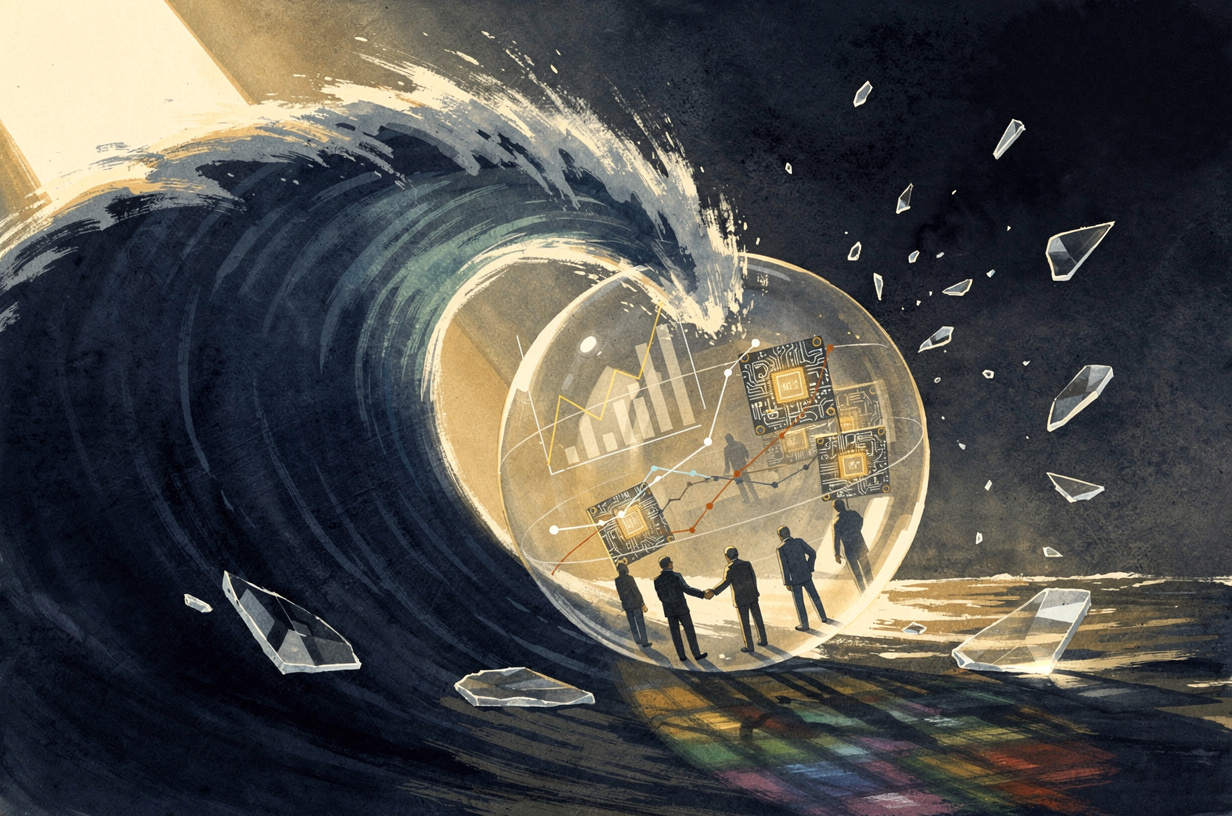
Democrats flipped enough Republican-held House seats — with the Associated Press calling races through Wednesday night — to take control of both chambers of Congress. Wall Street had not fully priced in a divided government scenario, and the repricing was swift. By Thursday morning, the European STOXX 600 had erased its entire weekly gain, Micron recorded its steepest single-day decline since April 2025, and the AI sector absorbed a sell-off that typically takes months to materialize.
The specific fear driving the sell-off was not generalized political uncertainty but a targeted worry about AI infrastructure spending — the theory circulating on trading desks being that a Democratic-controlled Congress would scrutinize and potentially curtail federal contracts and incentives for data center buildout. Former President Trump responded to the Democratic sweep by threatening 300 percent tariffs, a figure that dwarfs the peak rates of roughly 25 percent imposed during his first term and the approximately 60 percent applied to select Chinese categories during the 2025 escalation. Whether the threat represents negotiating posture or genuine policy intent, supply chain executives cannot afford to treat it as merely rhetorical.
Senator Elizabeth Warren moved quickly to signal the new majority's intentions, issuing warnings to donors who contributed to Trump's presidential library — a pointed indication that Democrats intend to use committee gavels for financial oversight and investigative hearings, not just legislation. The Wall Street Journal reported that Trump privately told aides that immigration enforcer Stephen Miller 'went too far' after Melania Trump complained that acquaintances were being swept up in deportation operations — a remarkable window into an enforcement apparatus that had scaled beyond the feedback loops that might have moderated it.
Scott Wiener, a California state senator known for housing density and technology policy work, won Nancy Pelosi's former San Francisco House seat, defeating Pelosi-endorsed Connie Chan to become the city's first openly gay member of Congress. His victory suggested the district wanted a sharper tech-policy focus heading into a Congress that will make consequential decisions about AI regulation. The speed of the post-election realignment — market moves, tariff threats, leadership challenges, and investigative signals all arriving before the week was out — indicated that Tuesday's results did not merely shift congressional control. They reshuffled every political calculation in Washington simultaneously.
Data Centers Under Fire: Industry Confronts the Political Cost of Moving Too Fast

Tech leaders are publicly acknowledging that the AI industry helped fuel the political backlash against data centers — admitting, in essence, that the sector moved too fast, failed to bring communities along, and is now paying the price. The scale of data center construction over the past three years has been extraordinary, with billions of dollars in infrastructure consuming enormous amounts of energy and water, often in communities that were not consulted or compensated proportionally for the disruption.
The most striking single data point is Texas governor-elect Hinojosa's pledge to ban new data centers in the state. Texas had been among the primary destinations for data center investment precisely because of its permissive regulatory environment and abundant land. A ban, if pursued, would reshape the entire industry's geographic calculus — though real questions remain about enforceability given federal contractors, interstate commerce, and existing lease agreements involved in data center operations.
Adding to the pressure, an anonymous seller has put $500 million in data center loans on the market with no name attached. That kind of anonymized distressed-sale posture typically signals either an institution that does not want the market to know it is de-risking — because the signal would affect its other positions — or a strategic seller seeking price discovery without revealing its hand. Either way, half a billion dollars in data center debt hitting the market anonymously in the same week Micron is plunging compounds the narrative of an industry under simultaneous pressure from multiple directions.
A Democratic Congress engaging in antitrust scrutiny of AI hyperscalers faces a meaningful legal threshold, as the Sherman Act requires proving not just large market share but that a company acquired or maintained monopoly power through exclusionary conduct rather than superior competition. Whether the dominance of a handful of hyperscalers — Microsoft, Google, and Amazon controlling the majority of cloud compute — constitutes actionable antitrust conduct is a genuinely contested legal question that any new enforcement action would have to clear. Meanwhile, Perplexity's launch of Teammates, persistent AI agents designed for ongoing collaborative work, represents a product that may face lighter regulatory exposure than the hyperscalers, potentially opening space for second-tier AI companies in the new political environment.
Billion-Dollar Bets on Uncertain Ground: AI Valuations Face a Reality Check

Mira Murati's new lab, Thinking Machines, is reportedly nearing a $5 billion funding round led by Accel at a $40 billion valuation — roughly one year after Murati departed OpenAI, where she served as chief technology officer, and without any publicly released product. The valuation is a founder bet: investors are purchasing Murati's judgment, network, and credibility from years at the center of some of the most consequential AI decisions of the past several years. Accel, whose early bets include Facebook, Slack, and Dropbox, anchoring the round lends the thesis institutional credibility.
In contrast, Anthropic is reportedly pursuing an initial public offering at a $1.5 trillion valuation, and investors are balking. That figure would place Anthropic alongside Apple, Microsoft, and Nvidia — companies generating hundreds of billions in annual revenue. Anthropic's revenue, while growing rapidly, is nowhere near that scale. The bull case requires believing that AI will restructure the global economy and that Anthropic will capture a substantial share of the resulting value — a claim requiring many things to go right simultaneously.
An outside study finding that Anthropic's AI is improving twice as fast as competitors makes that bull case more legible, since a steeper improvement curve over eighteen months would produce a widening capability differential that competitors could not easily close. But investor skepticism about the $1.5 trillion figure has deepened in the days since the Democratic sweep, as a Congress that may impose compliance costs, liability frameworks, or operational restrictions shifts the risk calculus further against the bulls.
The ChatGPT lawsuit filed by James Gates adds legal uncertainty to the valuation environment across the sector. Gates alleges that ChatGPT provided his wife with advice on using oleander as a poison and concealing evidence; criminal charges against the wife were dropped in April, but the civil suit is proceeding. The case raises unresolved questions about AI company liability when a model provides harmful information a user then acts on — territory where Section 230, designed for platforms hosting user-generated content rather than systems generating novel responses, may not apply cleanly. If the suit advances far enough to establish legal principles, it could create precedent reshaping what AI companies must prevent their models from discussing, with consequences for every valuation in the sector.
Tehran's Seven Conditions: Iran Sends a Nuclear Proposal Through Qatar at a Calculated Moment

While Washington processed its midterm results, Iran transmitted a formal nuclear proposal to the United States — seven specific conditions — through Qatari intermediaries. The timing was deliberate: Iranian officials have been watching American political cycles closely and assessed the post-midterm window, before the new Congress is seated, as a moment for diplomatic movement. The Qatari channel has served as the primary back-channel for Iran-U.S. communications for several years, with Qatar's unusual position as host of the largest U.S. military base in the Middle East while maintaining diplomatic relations with Tehran enabling it to hold the channel open.
Senior Iranian officials told Reuters that talks are contingent on American compliance with the seven conditions — positioning Iran as the party setting terms rather than seeking relief. The parliamentary speaker meanwhile publicly mocked Vice President Vance for suggesting the ongoing conflict contributed to Republican midterm losses, responding essentially that if American voters turned against their party over a war, the responsibility lies with American policy failures. The two-track approach — private terms through Qatar, public political commentary aimed at American domestic audiences — reflects a layered Iranian strategy.
The fear referenced in reporting — that the conflict could 'resume' after the midterms — implies a de facto pause or reduced intensity in hostilities during which this diplomatic opening is occurring. A Democratic Congress, historically more skeptical of open-ended Middle East military engagement than the Republican majority it replaced, potentially changes Tehran's calculation about whether this moment favors a deal. The capacity question looms large: a nuclear negotiation requires sustained, focused engagement from senior American officials who are simultaneously managing a domestic political crisis of historic proportions, a hostile new Congress, and an executive branch in constant turbulence — circumstances in which Qatari mediators' ability to hold a channel open may prove essential.
Fractures on Both Sides: Republican Infighting and Democratic Leadership Battles Begin
The Wall Street Journal's post-mortem reporting reveals that Trump privately told aides Stephen Miller 'went too far' with deportation operations after Melania Trump complained that her personal acquaintances were caught in the enforcement machinery. The account suggests the operations had scaled to a scope that was touching personal networks of people close to the president — a sign both of how broad the operations had become and of how insulated their execution had grown from moderating feedback. The leaks targeting Miller spreading in the wake of Republican electoral losses signal that his position within the administration is weakening; when a party loses power, internal coalition members who stayed quiet while winning begin providing information to journalists.
On the Democratic side, incoming senators are already pushing back on Chuck Schumer remaining as Senate Democratic leader — a significant signal that the new class, elected on platforms of economic fairness, climate, and AI accountability, wants a fighter in leadership rather than a negotiator. Schumer has led Senate Democrats since 2017, managing extraordinary complexity including a 50-50 Senate, but effective procedural management is a different skill set than mobilizing a majority caucus spanning moderate red-state Democrats and progressive firebrands.
Warren's warnings to Trump library donors signal that Democrats intend to use their new investigative powers on financial accountability — library donations are legal but not fully transparent, and that opacity becomes politically meaningful when the opposition controls committee gavels. At the state level, California's Proposition 42, a constitutional ban on wealth taxes, appears headed toward passage — a preemptive response to progressive efforts to tax unrealized capital gains or net worth, suggesting California voters draw distinctions between forms of progressive taxation even in a heavily Democratic state. Colorado's Amendment 87, a graduated income tax proposal to end the state's 4.4 percent flat rate, remained in a tight race with the AP yet to call it, as supporters declared victory on a narrow lead still being counted.
Market Turbulence: Reading the Signals Behind the Sell-Off

S&P futures showed a modest recovery Friday morning — approximately 7,400, up roughly 17 points from overnight lows — after a week in which the AI and semiconductor sectors absorbed significant losses. Micron's worst single session since April 2025, triggered by a pause on its Taiwan facility expansion, is the clearest single-company expression of a broader investor doubt: if a Democratic Congress grows more restrictive on AI infrastructure, the demand assumptions underpinning aggressive capacity expansion no longer hold. The Taiwan dimension adds geopolitical texture, as any major manufacturing decision by a U.S. semiconductor company on the island operates against the backdrop of elevated U.S.-China tensions.
The anonymous $500 million data center loan sale compounds the narrative. Five hundred million dollars is not a small position to unload, and obscuring the seller's identity through the sale's structure typically points to an institutional player — a bank or fund — holding other positions in the same sector and unwilling to signal broader de-risking. Three separate actors responding to the same underlying anxiety — the STOXX 600 erasing weekly gains, Micron plunging, and an anonymous distressed debt sale — represent a market trying to price what a Democratic Congress will actually do to AI infrastructure and over what timeline.
Trump's 300 percent tariff threat adds a variable that a Democratic Congress cannot easily constrain. Executive tariff authority under Section 232 and Section 301 of existing trade law does not require congressional action, meaning the check on such tariffs lies with the courts, trading partners' retaliatory capacity, and the economic damage that would flow back to American consumers and businesses — not with the new House majority. The practical implication is that markets are treating the tariff threat seriously in a divided government context precisely because it falls within unilateral executive power.
The underlying volatility, as one reading of the week's events suggests, represents uncertainty repricing rather than a fundamental reassessment of corporate value. When a major political variable resolves in an unexpected direction — Democrats sweeping when polls indicated a closer race — positions built on the old probability distribution must be unwound. That unwinding is what the AI and semiconductor sell-off represents. Whether it reflects the worst-case regulatory outcome or an overcorrection that creates opportunities for patient investors remains the defining question heading into next week.
At the Frontier: What Is Actually Being Built Beneath the Market Noise

An outside study — not conducted by Anthropic itself — finds that Anthropic's AI models are improving twice as fast as competitors on measured benchmarks, with particular strength noted in multi-step logical reasoning and long-context comprehension over the past twelve months. The competitive significance extends beyond current capability: a faster improvement rate, if sustained, produces a widening differential over time that competitors cannot easily close by playing catch-up. That trajectory data is what made a $1.5 trillion IPO valuation legible to bullish investors, even as skeptics balk at the gap between current revenue and implied market position.
Thinking Machines represents a qualitatively different investment thesis — a human capital bet on Mira Murati's ability to reproduce the organizational conditions that produced GPT-4 and subsequent OpenAI model generations. Accel leading the reported $5 billion round anchors a valuation of $40 billion for a lab without publicly released products, reflecting AI investor psychology as much as conventional valuation methodology.
Perplexity's Teammates product addresses a fundamental technical limitation of current AI assistants: statefulness. Every new conversation with most AI systems begins with no memory of prior interactions, creating re-contextualization overhead that limits deep workflow integration. Persistent agents that maintain context across sessions and track ongoing projects represent a meaningfully different interaction model — more like a junior colleague than a one-shot search interface. The compute implications are significant: persistent agents require sustained inference capacity rather than the burst capacity needed for single queries, which is part of why data center buildout has been accelerating even as individual query costs decline.
What If the Bears Are Wrong? Testing the Consensus on Democratic AI Policy

The ChatGPT lawsuit filed by James Gates — alleging that the chatbot provided his wife with actionable advice on using oleander as a poison and concealing evidence — illustrates unresolved liability questions that complicate every AI valuation in the sector. Criminal charges against the wife were dropped in April, but the civil case is proceeding into genuinely novel legal territory. Section 230, designed for platforms hosting user-generated content, was not built for systems actively generating novel responses to queries; whether and how it applies to generative AI outputs remains unsettled. A ruling that establishes precedent on AI company liability for harmful model outputs could reshape what AI companies are legally required to prevent their systems from discussing.
Against that legal backdrop, the dominant market narrative holds that a Democratic Congress will slow AI development, increase regulatory burden, and justify the current valuation markdown in AI stocks. That consensus deserves scrutiny. Democratic skepticism of Big Tech has historically focused on privacy, monopoly power, and algorithmic bias — not on AI development or infrastructure buildout per se. Democratic constituencies including construction unions, municipalities benefiting from data center tax revenue, and universities receiving research funding have direct economic reasons to want AI investment to continue.
The national security argument also cuts against aggressive AI slowdown: any Congress that meaningfully impedes American AI development while China continues investing in its own AI sector faces political backlash from the security community and industrial policy advocates who view AI leadership as strategically essential. Historically, congressional oversight tends to produce compliance regimes — documentation requirements, safety testing mandates, liability frameworks — rather than outright capacity restrictions. The regulatory path most likely to emerge may increase costs and add friction without halting construction or prohibiting model training.
The specific, falsifiable indicator to watch: which committee hearings get scheduled in the first sixty days. If Democrats prioritize investigations into executive branch conduct — consistent with Warren's library donor warnings — AI regulation may take a back seat to oversight, producing a less disruptive outcome than markets are currently pricing. If committee chairmanships immediately target AI with an adversarial frame, the bearish read is probably correct. The Schumer leadership contest is a parallel leading indicator: a Schumer-led Senate tends toward procedural caution and deal-making, while a Senate led by one of the progressive insurgents now challenging him could be more aggressive on tech regulation specifically. First hearing invitations and the leadership contest outcome will reveal more about this Congress's actual trajectory than any amount of post-election analysis.