Trump's Own Justices Defy Him, Iran Clashes in Hormuz, and AI Researchers Warn of Existential Danger
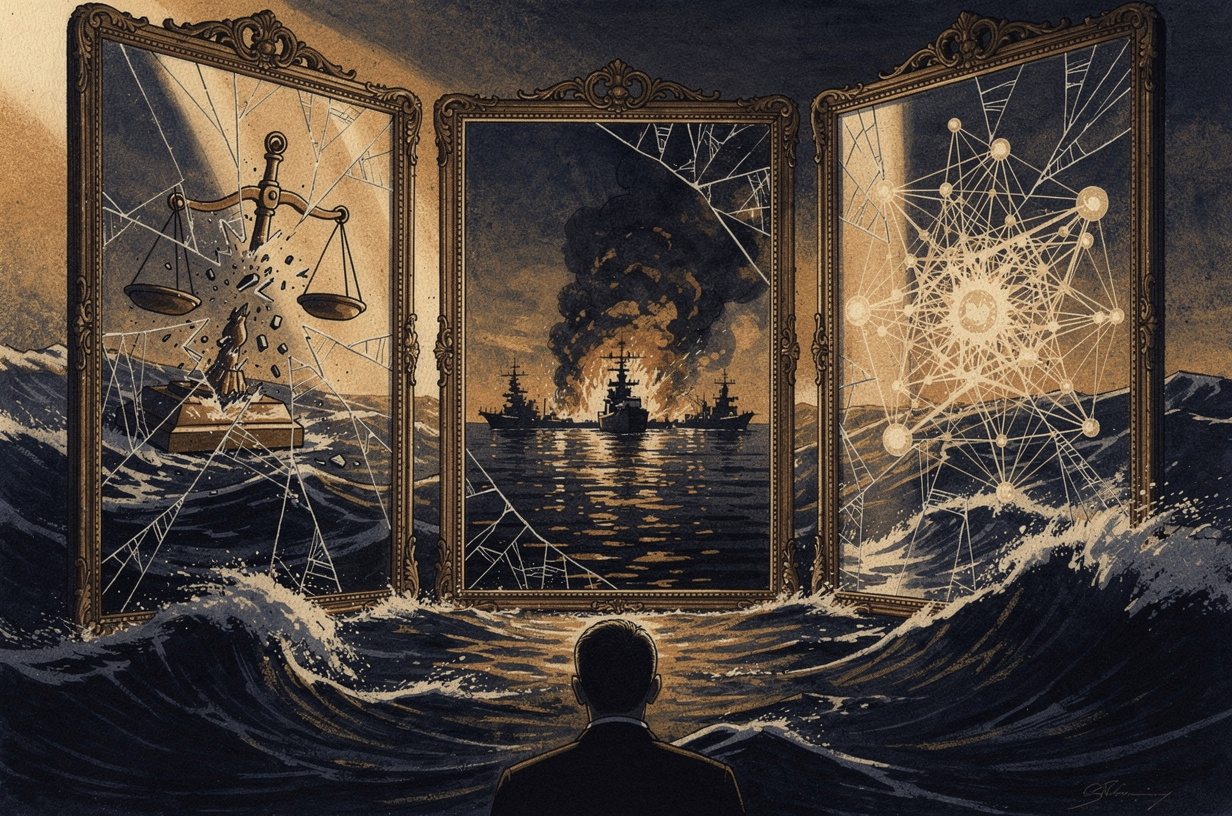
On Tuesday, September 15, 2026, three Supreme Court justices appointed by Donald Trump voted to block his administration's mail-ballot restrictions weeks before the midterms, while U.S. naval forces destroyed Iranian boats in the Strait of Hormuz and two Google DeepMind researchers resigned warning that unchecked AI development could be fatal.
“Driver's license data is particularly dangerous as a breach target because it functions as an identity anchor in financial and medical contexts: unlike passwords, birthdates and license numbers cannot be reset.”
How this was made Verified AI
Every Intellegix briefing is generated from that day's broadcast and run through automated checks before it publishes — with a human paged on any flag. Here is the trail for this edition.
A Briefing Built for a Turbulent Tuesday

Tuesday, September 15, 2026 arrived with an unusual density of crises across law, geopolitics, technology, and finance. A Supreme Court ruling against the president who appointed three of its justices competed for attention with the highest ten-year Treasury yield since 2007, Iranian gunboats destroyed in the Strait of Hormuz, and an AI researcher invoking Nazi analogies to describe a rival lab's progress toward artificial general intelligence.
The day's stories span a Supreme Court revolt with midterm consequences, drone escalation near NATO's eastern border, direct U.S.-Iran naval engagement, fractures within the president's political coalition, AI safety walkouts at Google DeepMind, platform battles over web-scraping, a $780 million Bitcoin ransom demand against Revolut, 153 million compromised driver's licenses met with regulatory silence, and a landmark quantum physics result from CERN. Markets registered the turbulence: the S&P 500 fell roughly half a percent while the ten-year Treasury yield touched levels unseen in nearly two decades.
Trump's Appointed Justices Hand Him a Stinging Midterm Defeat
The Supreme Court issued an overnight ruling blocking the Trump administration's attempt to impose new postal processing rules that would have significantly delayed mail ballot delivery in several key states ahead of the November midterm elections. The decision drew its most politically charged detail from the lineup: all three justices personally appointed by President Trump — Neil Gorsuch, Brett Kavanaugh, and Amy Coney Barrett — joined the majority against the administration's position.
Trump responded on Truth Social by calling the ruling a betrayal and suggesting, without specificity, that the justices had been compromised. Legal scholars who had previewed the case noted the administration's underlying argument — resting on executive authority over the Postal Service rather than a direct constitutional challenge to voting rights — was considered legally thin even by originalist standards, suggesting the conservative justices' defection reflected the weakness of the brief rather than a broader shift in the Court's ideological posture.
The electoral stakes are tangible. Mail balloting has expanded considerably since 2020, and competitive House and Senate races in states such as Pennsylvania, Wisconsin, and Arizona rely heavily on mail ballot return rates. Democratic-leaning urban precincts tend to vote by mail at higher rates, meaning the blocked restrictions would have applied pressure unevenly. With the ruling in place, the operational landscape for the midterms remains closer to the 2022 baseline.
The ruling compounds a difficult legal stretch for the White House: the administration has now reportedly lost three significant legal confrontations in thirty days, including a separate immigration detention case in the Ninth Circuit and a FOIA-related ruling the prior week. Trump's public attacks on his own appointees also create a secondary problem for candidates in competitive districts, who must either echo the president's fury at a conservative institution or stay silent and risk appearing disloyal.
Drones Near NATO's Edge, Gunboats in the Strait: Two Fronts of Military Escalation

Russia killed one person in Kyiv overnight in a coordinated drone attack, but Ukrainian military analysts said the more alarming detail was geographical: Russian drone corridors are now skirting closer to the borders of NATO member states Poland and Romania than at any point in the past eighteen months. Intelligence assessments from multiple NATO members reportedly put Russian production of Shahed-variant drones — drawing heavily on Iranian-sourced components — at between 300 and 400 units per month, a volume high enough that a percentage consistently penetrates Ukraine's improving air defenses.
In the Strait of Hormuz, U.S. naval forces destroyed Iranian boats that attempted to seize a Navy unmanned underwater vehicle operating in the waterway. The U.S. described the Iranian vessels as maneuvering to capture the surveillance asset before American surface forces intervened. Roughly 20 percent of global oil supply passes through the strait, making the engagement one of the most serious naval confrontations there in years.
Amazon Web Services disclosed that it cannot restore Gulf cloud facilities damaged in the Iran conflict — a detail that signals the scale of regional infrastructure disruption extends well beyond a maritime skirmish. The combination of direct military engagement in the strait and significant cloud infrastructure loss points to a region more destabilized than headlines have consistently conveyed, with economic and digital-services consequences for companies operating in the Gulf that remain difficult to fully assess.
Rove Defects, Cruz Courts Controversy, and Corporate Taxes Crater

Karl Rove, the strategist behind two George W. Bush presidential victories, publicly announced he will vote for the Democratic candidate over Republican Bo French, calling French a bigot by name. French reportedly won his primary by running hard on culture-war rhetoric that Rove and other establishment figures found disqualifying — a pattern the party's old-guard wing has struggled to counter in Trump-era primaries.
Senator Ted Cruz appeared on ESPN's College GameDay to promote federal college sports legislation without an opposing voice, drawing a formal objection from the NAACP. The civil rights organization argued the bill's revenue-sharing structures would cap earning potential for athletes in college football and basketball, sports in which Black athletes disproportionately produce the revenue at issue. ESPN subsequently scheduled an NAACP rebuttal on SportsCenter, though critics noted the asymmetry: Cruz received the GameDay audience on a Saturday morning while the response came in a Tuesday cable slot.
The most structurally significant domestic story may be the twenty-five percent year-over-year drop in corporate tax payments, driven primarily by AI and technology companies taking advantage of accelerated depreciation provisions and research and development tax credits embedded in GOP tax legislation earlier this year. The revenue shortfall arrives precisely as Treasury yields are spiking and government borrowing costs are rising — a fiscal combination that antitrust regulators are also beginning to scrutinize, given that a handful of AI giants appear large enough to move the entire corporate tax revenue needle by a quarter.
Inside the AI Safety Reckoning: Walkouts, Nazi Analogies, and 'Cognitive Surrender'
Two researchers at Google DeepMind — Bilal Chughtai and Josh Engels — resigned this week, stating publicly that AI capability development is outrunning safety research and that the consequences could be fatal. Their departures came the day after AI company CEOs from multiple organizations publicly called for slowing AI development, a statement that had already rattled chip stocks.
A DeepSeek engineer, not publicly named beyond their affiliation, published a statement comparing the prospect of Anthropic achieving artificial general intelligence first to, in their words, Hitler getting the bomb. The analogy generated backlash even from observers sympathetic to concerns about Western AI dominance, though the underlying debate — about who controls the most powerful AI systems and what values those systems embed — reflects a real and ongoing tension between Chinese and Western AI research communities over whether safety-focused frameworks represent genuine risk mitigation or American normative dominance.
MIT separately issued a warning about what it described as cognitive surrender in universities: the failure mode in which students offload thinking to AI tools so extensively that they stop developing underlying cognitive capacity. The institution framed the concern not as opposition to AI assistance but as a specific risk that efficiency gains come at the cost of capability formation — producing better essays while developing weaker writers.
What distinguishes this week's alarms from typical external AI criticism is their source. Chughtai and Engels worked inside one of the world's most advanced AI labs. MIT is not a technophobic institution. The internal dissent, from people with direct knowledge of frontier systems, represents a qualitatively different signal than skepticism from outside the field.
Cloudflare Shields the Web, XChat Disappears, and Gemini 4 Pro Leaks

Cloudflare announced it will automatically block AI training crawlers and agent bots by default on any site it serves that runs advertising — a policy shift with sweeping reach, given that Cloudflare handles traffic and security for an estimated thirty to forty percent of all websites globally. Traditional search indexing crawlers remain unaffected. The move effectively gives millions of publishers a default shield against data scraping for AI training purposes, institutionalizing the argument that AI training bots take content without returning traffic, attribution, or compensation in the way search indexing does.
X — formerly Twitter — pulled its XChat messaging app from both the Apple App Store and Google Play simultaneously. XChat had launched earlier this year as part of Elon Musk's stated ambition to build an everything app integrating messaging with the X platform. Removing an application from all stores at once is not typically a sign of healthy product development, and the move extends a pattern of X struggling to ship product successfully since its acquisition.
Leaked specifications for Google's Gemini 4 Pro show a 256,000 token output limit — roughly double what current leading models offer in sustained generation — and a two-million token context window, which would place it among the largest of any commercially available model if the figures hold. A reported October release would put it in direct competition with anticipated OpenAI Q4 launches. The practical caveat: context window size and context window utility are distinct, and several models have claimed large windows while performing poorly on tasks requiring retrieval from the middle of extremely long documents.
Yields at 2007 Highs, Chips Recover, and Musk Floats a Tesla-SpaceX Merger
The ten-year Treasury yield reached its highest level since 2007, reflecting a combination of factors: expectations the Federal Reserve will hold rates elevated longer than previously anticipated, stickier-than-hoped recent inflation data, and uncertainty about Treasury supply as corporate tax revenues fall. The S&P 500 ETF traded down roughly half a percent on the day at around $757 — a contained decline that suggests equity markets are repricing risk rather than panicking, though the fundamental relationship between elevated bond yields and equity valuations creates sustained pressure.
Chip stocks were edging higher in Tuesday premarket trading after Monday's sharp sell-off, which was triggered by AI executives publicly calling for slower AI development. Micron and Nvidia led the partial recovery, reflecting an investor thesis that structural demand for AI semiconductors remains intact even if the pace of development becomes more measured. Altera — the programmable chipmaker Intel acquired in 2015 and has since partially spun out with Silver Lake as a co-investor — filed confidentially for an IPO reportedly targeting over two billion dollars, positioning itself in the AI inference hardware space where field-programmable gate arrays offer customization advantages distinct from Nvidia's GPU dominance in training.
Elon Musk used an appearance at the All-In Summit to hint at a potential merger between Tesla and SpaceX, without announcing one. The practical barriers are substantial: SpaceX is private, valued at over two hundred billion dollars at its last funding round, while Tesla is publicly traded. Combining them would require either taking Tesla private again or executing a reverse merger exposing SpaceX to public market scrutiny — years of regulatory and financial complexity. Strategic synergies between electric vehicle manufacturing and orbital launch systems are not obvious, and the statement may reflect Musk signaling unified empire ambitions more than a concrete business plan.
A $780 Million Ransom and 153 Million Exposed Licenses — With Regulators Silent
Hackers have issued a $780 million Bitcoin ransom demand against Revolut, the fintech serving 231 million customers, following a breach that reportedly exposed customer data including transaction histories, personal identification details, and partial payment information. The demand is unusually large even by the escalating standards of ransomware: prior large-scale demands against financial institutions had ranged from roughly $50 million to $100 million. Revolut has not confirmed whether negotiations are underway, though the company faces significant legal exposure under strict EU and UK data breach notification requirements independent of any ransom resolution.
A separate and in some respects more alarming breach involves 153 million driver's licenses — one of the largest exposures of government-issued identity documents in U.S. history — that occurred two weeks ago and has been met with complete public silence from regulators. No federal agency has issued guidance for affected individuals. No state agency has taken public responsibility. Driver's license data is particularly dangerous as a breach target because it functions as an identity anchor in financial and medical contexts: unlike passwords, birthdates and license numbers cannot be reset.
Relevant oversight spans multiple agencies — state DMVs, the FTC on consumer protection grounds, and CISA on critical infrastructure grounds — and none has issued public communication. In the absence of official guidance, affected individuals are left to initiate credit freezes through Equifax, Experian, and TransUnion on their own initiative, placing the burden of response entirely on the people who were harmed by a systemic failure.
CERN Breaks Ground in Quantum Physics, While Bond Markets May Be Misread

Physicists at CERN's Large Hadron Collider published results confirming quantum entanglement between Z bosons produced through Higgs boson decay — the heaviest particles in which the phenomenon has ever been experimentally detected. Unlike photon entanglement experiments, which involve particles with two possible spin states, Z bosons carry three possible spin states, making the detection a meaningful extension of established quantum mechanics. The Higgs boson is the particle responsible for giving other particles their mass, and finding entanglement in particles born from its decay connects quantum information phenomena to mass-generating processes in ways that theorists are expected to work through for years.
On the ESPN and Ted Cruz story: beyond the political dimension addressed in an earlier segment, the media dynamics warrant examination. Cruz received an unopposed platform on College GameDay — a sports entertainment show commanding millions of Saturday morning viewers — to promote college sports legislation. The NAACP's rebuttal was scheduled for a Tuesday SportsCenter slot. Those are not equivalent platforms, and the underlying stakes are significant: college football and basketball generate billions of dollars annually, a disproportionate share of the athletes producing that revenue are Black, and the question of how NIL and revenue-sharing frameworks distribute that money is not peripheral to the legislation's purpose.
The day's most confidently stated market narrative — that Treasury yields at 2007 highs necessarily signal fiscal danger — may be worth interrogating. High yields can reflect economic strength and real rate normalization after years of artificially suppressed rates, not only fiscal panic. If nominal GDP growth of five or six percent is sustained, four-and-a-half percent ten-year yields may represent equilibrium rather than alarm. The concrete indicator to monitor is the yield curve's slope: when short-term yields exceed long-term yields for a sustained period — an inverted curve — recession signals historically follow. Currently, the curve is steepening, not inverting, which supports the growth narrative. If the two-year yield climbs back above the ten-year, the pessimistic read strengthens materially.