Cloudflare Swallows Deno, a National ID Database Falls to '123456,' and Half a Billion Dollars Flows Into Edge Hardware
A landmark acquisition reshaping the server-side JavaScript landscape, a password so weak it defies satire protecting millions of citizens' identities, and a surveillance reversal that sent police to a YouTuber's front door dominated a packed Saturday on Hacker News, where the day's top story alone drew more than 630 comments and a score of 1,253.
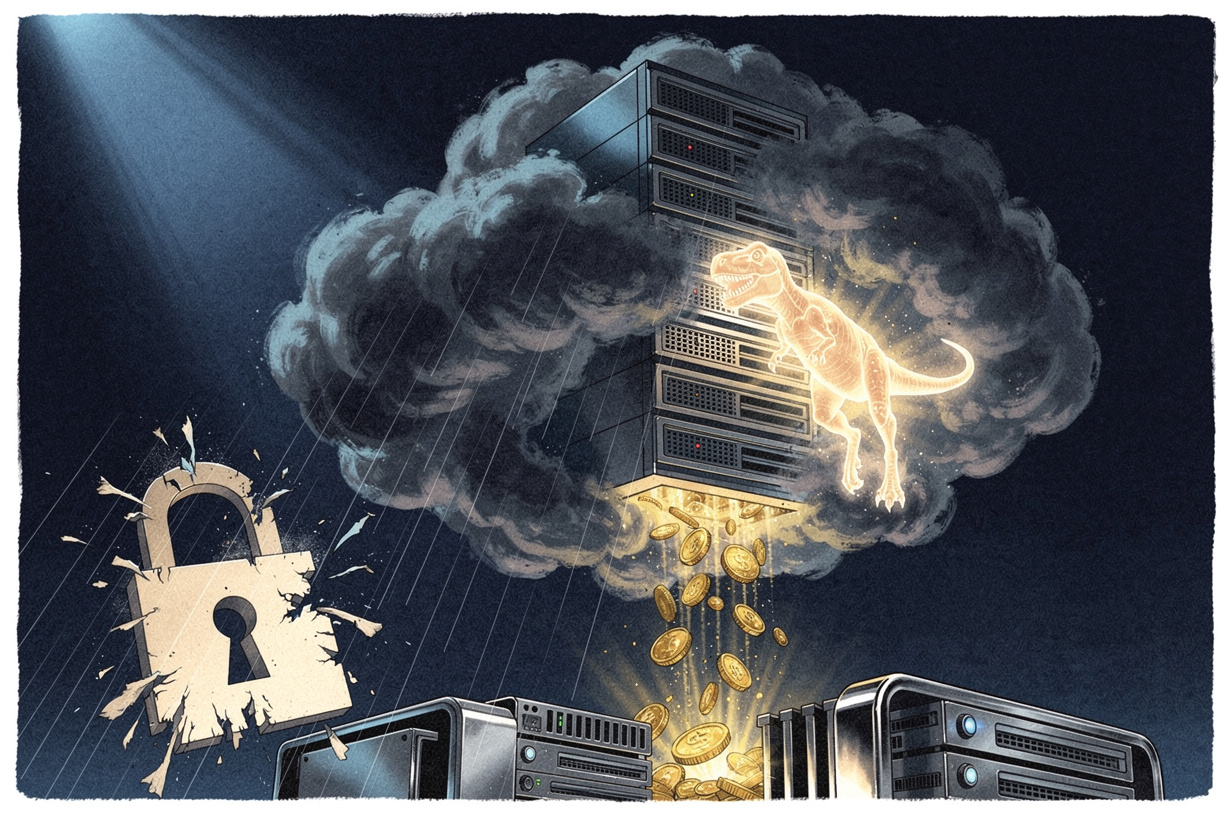
“Acquiring Deno means acquiring that knowledge base, not merely its software.”
How this was made Verified AI
Every Intellegix briefing is generated from that day's broadcast and run through automated checks before it publishes — with a human paged on any flag. Here is the trail for this edition.
From CDN to Runtime: Cloudflare Absorbs Deno in a Deal That Rewires Edge Computing

Cloudflare has acquired Deno, the JavaScript and TypeScript runtime created by Ryan Dahl — the same engineer who originally built Node.js — in a move that immediately became the most-discussed story on Hacker News Saturday, drawing a score of 1,253 and more than 634 comments before midmorning on the East Coast.
The strategic logic is almost uncomfortably clean. Cloudflare's Workers platform already runs JavaScript at the edge — distributed across data centers close to end users — and has been investing heavily in runtime compatibility. Deno brings built-in TypeScript support, a security-first permissions model, the JSR package registry, and, critically, the core engineering team that has spent roughly a decade accumulating deep knowledge of how to make JavaScript fast and correct at the runtime level. Acquiring Deno means acquiring that knowledge base, not merely its software.
Reaction in the HN thread split into two clear camps. One group welcomed Cloudflare committing real resources to the open-source ecosystem and saw the deal as likely to accelerate Deno's development. The other raised the classic acquisition concern: what happens to Deno's independence, whether JSR remains a neutral community registry, and whether Deno's technical roadmap eventually gets subordinated to Cloudflare's commercial priorities. Deno's announcement post addressed those questions directly, stating the runtime would remain permissively licensed and JSR would stay open — commitments the community noted will be proven or disproven in execution, not in press releases.
The acquisition also reshapes the competitive landscape beyond Cloudflare's own customers. Vercel's Edge Runtime is itself built partially on Deno internals, and AWS operates Lambda@Edge in the same space. If Cloudflare exerts meaningful influence over Deno's direction, it gains leverage over the shared substrate that competing edge platforms depend on — a competitive moat extending well past its direct user base. The HN discussion also flagged Bun, the third major JavaScript runtime that has been growing rapidly on a performance narrative, as the most exposed independent player now that Cloudflare has backed Deno. Whether Bun attracts a counter-move from Vercel, AWS, or Microsoft was an open question by day's end.
Cloudflare launched as a company that made DNS faster. It now operates across DNS, DDoS mitigation, zero-trust networking, edge compute, and runtime development — a footprint that the acquisition of Deno extends one layer deeper into the web infrastructure stack.
Password '123456' Guarded a Nation's Identity Data; Telegram Fell to a Single Click

Denmark's CPR system — the Civil Personal Registration database that functions as the country's national identity infrastructure, used for healthcare, banking, tax filing, and voting — suffered a significant data breach, and the authentication protecting sensitive records was the password '123456.' That was not a simplified description. That was the actual credential.
The HN comment section ranged from dark humor to substantive technical analysis. Several commenters noted that '123456' has topped every major 'most common password' list for well over a decade and appeared in more than 23 million breached accounts in the 2019 Have I Been Pwned dataset — making this not an obscure failure mode but a universally documented one, applied to a national identity database. CPR numbers in Denmark carry the same weight as Social Security numbers in the United States, and identity fraud enabled by their exposure can persist for years after a vulnerability is patched. The HN discussion included analysis of whether Denmark's data protection authority, Datatilsynet, would pursue enforcement under GDPR, where fines for serious violations can reach four percent of global turnover. More broadly, commenters noted that government IT systems in many countries run on aging infrastructure, maintained by contractors with varying security expertise, and often exempted from the penetration testing that private-sector organizations face — suggesting the Danish breach reflects a category of vulnerability likely present in government systems well beyond Denmark.
A separate security disclosure, scoring 200 points and drawing 95 comments, described a one-click account takeover vulnerability in Telegram Desktop. A researcher found that a malicious file delivered through Telegram's own file-sharing mechanism could, when a victim clicked a single link or opened a specific attachment, expose session credentials and grant full account control to the attacker with no additional authentication required. The vulnerability has since been patched. The disclosure renewed scrutiny of Telegram's broader security architecture: unlike Signal, Telegram does not use end-to-end encryption by default for regular chats, reserving that protection for 'Secret Chats' — a design choice that has drawn sustained criticism from security researchers and that makes a session-theft vulnerability particularly damaging to the platform's privacy-focused brand.
The week's most philosophically pointed security story involved a YouTuber who built a Flock-style automated license plate reader system and aimed it at police vehicles. Flock Safety's ALPR networks — installed on utility poles and intersections across hundreds of American cities — scan and log civilian vehicles continuously without individualized warrants, under minimal state-level legal frameworks. The YouTuber applied functionally identical technology to the cars of the agencies that operate that infrastructure. Police officers subsequently appeared at his home. The HN thread, which drew more than 300 comments, debated First Amendment dimensions, the practical legality of aggregating observations of vehicles on public roads, and what it signals about law enforcement's posture toward civilian use of surveillance technology it considers its own domain. The YouTuber's account suggested the visit was more informal message than specific legal action — which commenters noted carries its own implications.
Developer Tools: AI-Assisted Reverse Engineering, WSL3 Gains, and the Emacs Escape That Wasn't

The tool generating the most genuine excitement among developers Saturday was REA — Reverse Engineer Anything — which drew 461 upvotes and 181 comments. REA applies AI assistance to the reverse engineering workflow, helping analysts work through binaries, understand assembly, document undocumented APIs, and reconstruct program logic from compiled artifacts. The comment section read, by multiple accounts in the thread, like a reunion of everyone who has ever spent a weekend disassembling a binary.
Reverse engineering occupies a legally complex position: the European Union's Software Directive explicitly protects interoperability-motivated reverse engineering, while the United States' DMCA anti-circumvention provisions create genuine ambiguity. The HN discussion focused primarily on legitimate research use cases — security research, malware analysis, auditing software without available source code — and the potential for AI assistance to meaningfully lower the expertise barrier. Reading x86 or ARM assembly, inferring data structures from memory layouts, and tracing execution paths manually has traditionally required deep specialization; AI pattern-matching against known libraries and suggesting probable high-level equivalents for assembly sequences could accelerate that work for researchers who currently do it professionally.
A separate reverse-engineering item — Carrier Explode, a tool that decodes the carrier settings files pushed silently to iPhone, Pixel, and Galaxy devices — scored 336 points. Those configuration bundles control APN settings, visual voicemail, roaming behavior, and various network features, and have historically been entirely opaque to users. The tool renders them human-readable, which commenters noted has real practical value for diagnosing unexplained behavioral changes after carrier updates and for understanding the degree to which carriers configure devices without user visibility.
WSL3 benchmark data showed the Windows Subsystem for Linux's third iteration running five to sixty percent faster than WSL2 depending on workload. The wide range reflects WSL3's different virtualization approach, which reduces overhead specifically for I/O-heavy operations: file system and network workloads show the largest gains, while pure compute workloads that don't cross the host boundary improve less dramatically. If the benchmarks generalize across hardware configurations, the HN discussion suggested Windows becomes a meaningfully more attractive platform for developers who need Linux tooling in Windows-centric professional environments.
The Emacs story that closed out the developer tools conversation — titled 'I tried to move my notes out of Emacs. I failed. Again.' — drew 38 upvotes and 39 comments, an engagement rate that suggested everyone who encountered it had something to say. The author documented a latest failed migration attempt to Obsidian and the inevitable return to Org-mode. The HN community's explanation for why Org-mode migrations fail was characteristically precise: no other tool simultaneously handles outlining, task management, spreadsheets, literate programming, and publishing in a composable way, with four decades of community extensions. The switching cost, as several commenters framed it, is not learning a new application — it is permanently accepting that each of those functions will be done slightly worse.
Terence Tao on Proof Assistants, AI Mining Four Centuries of Field Notes, and Cats That Blink Back

Fields Medal winner Terence Tao published a blog post addressing what mathematicians should know about the Lean theorem prover — specifically, questions of reliability and AI's role in formal mathematics — drawing 129 upvotes and 25 comments. Lean is a proof assistant: a programming language in which mathematical proofs can be expressed and formally verified by computer. It has been gaining traction as AI models are increasingly used to help generate proof steps, and several high-profile results have been formalized within it.
Tao's post, as read by commenters, addresses two related questions. First, how reliable is Lean itself — can a proof Lean accepts be trusted as correct? The answer is nuanced: Lean's kernel is small enough to be audited and trusted, but the broader library ecosystem on which most proofs depend can contain its own errors. Second, what does AI assistance actually guarantee in this context? A proof step that an AI suggests and Lean formally accepts is verifiably valid — but Lean can only verify formal validity, not whether the formal statement correctly captures the mathematical question the researcher actually intended to ask. That gap between formal correctness and mathematical meaning — the specification problem — means AI assistance does not obviously resolve the deepest layer of uncertainty, and may introduce high confidence in a subtly wrong answer if the formalization itself is off. Tao's optimism about AI in mathematics, the discussion noted, is explicitly conditioned on recognizing this problem remains unsolved.
The more immediately striking AI application surfaced in a post about mining four centuries of historical archives, which drew 151 upvotes and 77 comments. A researcher ran AI analysis across digitized naturalist field notes, expedition records, and specimen catalogs spanning roughly 400 years, and surfaced findings human researchers had missed: a forgotten meteorite impact record, documentation of rhinoceros populations in regions where they are now considered never to have lived, and several other rediscoveries. The economic case for digitized archives has always been theoretically clear and practically underdeveloped because reading four centuries of handwritten field notes is an enormous undertaking. Language models capable of handling historical orthography, cross-referencing across documents, and flagging anomalous entries change that calculus — extending researchers' reach across document collections that would otherwise require lifetimes to process manually.
Jane Street's engineering blog contributed a post on autoregressive diffusion for generating synthetic market data, sitting at the intersection of AI and quantitative finance. The firm explored whether diffusion models trained on historical market data could generate synthetic scenarios preserving real markets' statistical properties — fat tails, time-varying autocorrelation structures, discrete price levels, and feedback loops between prices and participants. Practical applications would include backtesting trading strategies against synthetic scenarios rather than being limited to historical data, stress-testing against tail events, and reducing the overfitting risk that comes from repeatedly testing against the same historical record. The post reached appropriately cautious conclusions.
From the 'paper awaiting its viral moment' category: a 2020 Nature study from the University of Sussex on cat slow blinks resurfaced on HN with 90 upvotes and 36 comments. The research found that cats use eye-narrowing as a positive affiliative signal toward humans and that humans can reciprocate with measurable effect. The comment thread was, by general consensus, charmingly empirical.
Hardware's Big Bet, a Prion Disease Milestone, and the Processed-Food Brain Signal

Oxide Computer's $445 million Series D generated 664 upvotes and 297 comments — the day's second-highest-scoring story. Oxide builds rack-scale cloud computing hardware on a premise that runs against the prevailing drift toward public cloud: they believe a meaningful market exists for on-premises infrastructure that behaves operationally like a public cloud but runs on the customer's own hardware. Their approach integrates servers, firmware, networking, and the management plane into a single unified system designed and built by the same organization.
The market thesis targets customers for whom public cloud carries genuine drawbacks — heavily regulated industries with data residency requirements, organizations whose compute-intensive workloads make renting capacity from AWS or Azure economically worse than ownership, and customers that have decided cloud vendor lock-in is itself a business risk worth paying to avoid. Four hundred and forty-five million dollars represents a substantial institutional bet that on-premises infrastructure has a durable future alongside the hyperscalers rather than being displaced by them. The HN discussion reflected Oxide's passionate engineering following while also raising realistic questions about enterprise hardware sales cycles and whether the capital is sufficient to build the manufacturing and support operations that a hardware company requires at scale.
Typesafe AI's $870 million raise — drawing 284 comments — described a different capital flow: the enormous sums concentrating in enterprise AI infrastructure tooling, the layer between raw AI models and production enterprise applications. Investors are implicitly betting on a winner-take-most dynamic in that category, though the HN discussion noted healthy skepticism: the space is crowded, competitive moats remain unclear, and valuations across enterprise AI tooling have been running well ahead of revenue for most participants.
The clinical trial announcement that received the most measured reaction was the enrollment of a prion disease drug candidate at the Broad Institute. Prion diseases — including Creutzfeldt-Jakob disease and fatal familial insomnia — are uniformly fatal, currently have no approved treatments, and propagate through neural tissue via misfolded proteins. The HN thread was appropriately cautious: clinical trials fail frequently, and prior candidates in the prion disease space have not advanced to approval. But reaching clinical trial enrollment remains a meaningful milestone for a patient population that currently has no therapeutic options whatsoever.
Virginia Tech research on processed food and metabolism drew substantial discussion after finding measurable differences in metabolism and brain activity between people consuming highly processed versus minimally processed foods, controlling for caloric content and macronutrient composition. The brain activity component — using neuroimaging to show different activation patterns in response to eating — generated the most commentary, suggesting processing may affect reward and satiation signaling in ways that calorie-counting models do not capture. Commenters connected the findings to ongoing regulatory debates in the UK and Brazil around ultra-processed food labeling, arguing the research strengthens the evidence base for processing-specific disclosure beyond purely precautionary grounds. A related post on ingredient list manipulation practices — including ingredient splitting to push individual components further down mandatory by-weight lists, and rounding rules that allow sub-threshold quantities to be listed as zero — drew 143 comments examining the gap between technical regulatory compliance and genuine consumer information.
What If the Optimists Are Wrong About Cloudflare and Deno?

The day's most confident consensus — that the Cloudflare-Deno acquisition is a net positive for the JavaScript ecosystem — carries meaningful vulnerabilities worth examining. The optimistic case holds that Cloudflare gains runtime expertise and Deno gains resources and distribution, with JSR continuing as a neutral community registry that benefits all runtimes equally, including Bun and others. The historical analog is npm: a dominant package registry that works well for everyone is more valuable as a neutral utility than as a walled garden, and Cloudflare's incentives should push toward maximizing JSR's usefulness because developer adoption is what makes Workers valuable.
The cautious counterargument begins with the observation that the optimistic case depends on Cloudflare's leadership making consistently good long-term strategic decisions through personnel changes, quarterly pressure, and competitive shifts over a multi-year horizon. The assumption that a company will consistently choose long-term ecosystem health over short-term platform stickiness has been wrong before. The case study HN reaches for in exactly these situations is Oracle's behavior with Java following its acquisition of the company that originally created it — a platform that also came with assurances of continued openness.
The specific failure modes to watch, as the discussion identified them: JSR packages that work on Cloudflare Workers but fail silently on other runtimes; Deno tooling that favors Workers deployment without clear technical justification; governance changes to JSR that reduce community oversight of registry policy; and whether the core Deno team retains meaningful independence in setting the technical roadmap or whether product decisions begin flowing primarily from Cloudflare's commercial needs. If any of those signals materialize within eighteen months of the acquisition closing, the Oracle parallel becomes a serious concern. If, two years out, JSR still adds packages that run equally well on Bun and other runtimes and the Deno runtime continues developing features that serve Deno users rather than only Workers operators, the optimistic view was probably correct. The instruction from the discussion: watch the package registry governance, not the press releases.