AI Safety Rift, a Century-Old Kidney, and the Fight Over Rodin's Digital Doubles: Hacker News Unpacked
A Sunday on Hacker News collided philosophy, engineering, and cultural law — from a public feud over AI extinction risk to a French court ruling that could reshape who owns digital reproductions of humanity's greatest art.
How this was made Verified AI
Every Intellegix briefing is generated from that day's broadcast and run through automated checks before it publishes — with a human paged on any flag. Here is the trail for this edition.
Bob Cringely and the Humans Behind the Machines
The death of Bob Cringely — pen name of technology writer and PBS filmmaker Mark Stephens — prompted an outpouring on Hacker News that was equal parts grief and serious reflection. For many in the community, Cringely was the writer who first made technology feel participatory rather than merely consumable. His 1992 book 'Accidental Empires' remains one of the clearest accounts of how the personal computer industry formed: not through genius alone, but through luck, timing, and an unusual concentration of ambitious people in a small geography.
His PBS documentary series NerdTV offered long-form, unhurried interviews with figures like Doug Engelbart, Alan Kay, and Marvin Minsky at a moment when mainstream media was still chasing product launches. His I, Cringely column ran for decades, distinguished by a willingness to make bold predictions in public, revisit the ones that failed, and treat both outcomes with equal candor. The HN response had the particular quality that marks writers who genuinely mattered to a generation: readers sharing specific passages that changed how they saw something.
From one form of preservation to another — the Video Game History Foundation announced its digital archive has now surpassed 5,000 gaming magazines, including runs of Electronic Gaming Monthly, GameFan, and Nintendo Power. The VGHF frames the milestone not merely as archiving but as building research infrastructure: publications from the late eighties and nineties are primary sources for understanding the culture, marketing anxieties, and social norms of that era. The foundation has also been among the most effective advocates for copyright reform, having published research showing that roughly 87 percent of classic games are effectively out of print and unavailable through any legal commercial channel.
Complementing those digital preservation efforts, a long piece in Asterisk Magazine examined the electrician shortage with unusual depth — tracing why the apprenticeship pipeline is structured as it is and where the bottlenecks actually lie. The shortage is severe enough to act as a constraint on infrastructure projects, EV charging rollouts, and housing construction. A four-year electrical apprenticeship produces someone safety-certified and, in many markets, earning six figures without student debt — yet the absence of a bachelor's degree has left the path systematically devalued in cultural prestige terms for the last forty years. Licensing requirements that vary by state and municipality compound the problem: a journeyman-licensed electrician in Texas cannot simply move to work in California during a crisis without navigating an entirely separate credentialing process.
Completing the segment's thread between human labor and technological possibility, a man in Webster, New York marked the 100th birthday of the kidney his mother donated to him as a teenager — a milestone that no transplant pioneer predicted was achievable when the first such surgeries were performed. The immunosuppression regimens and careful long-term management involved represent a data point about the upper bounds of transplant medicine that the field is still working to understand. It is also, more simply, the story of a mother's gift keeping someone alive for a century.
Two Visions of AI Risk — and What Both Miss
The two most-commented AI stories on Hacker News this weekend are, in effect, a public debate in two acts. In the first, Yann LeCun, Meta's chief AI scientist, told Fortune magazine that he has zero concerns about AI wiping out humanity, going further to call Anthropic CEO Dario Amodei 'deluded' for his public statements about existential AI risk. LeCun's position is not new — he has been the most prominent skeptic of AGI extinction risk among senior researchers for years — and rests on the argument that current large language models are fundamentally limited in ways that make general intelligence, let alone dangerous superintelligence, considerably further off than what he characterizes as the 'doomer' framing suggests. His specific criticisms center on the absence of world models, the inability to reason causally, and brittleness under distribution shift.
LeCun is not dismissing AI risk categorically. He has argued consistently that more pressing dangers include bias, misuse, concentration of power, and what he calls the erosion of epistemic autonomy. His quarrel with Amodei is partly substantive and partly, observers noted in the 218-comment HN thread, about who controls the public narrative around AI danger. Several commenters argued that dismissing risk and dismissing the people who worry about risk are distinct acts — and that LeCun sometimes conflates them.
Act two arrived within days: a former member of OpenAI's safety team resigned and published a piece in The Atlantic describing OpenAI's culture as broken. The account, attributed to a named former employee, does not traffic in vague complaint. It describes concrete instances in which safety team input was ignored or overruled and an organizational structure that made it difficult for safety concerns to reach decision-makers in time to affect product choices — a structural critique, not merely a cultural one. The piece drew 507 comments on HN, placing it among the day's highest-engagement stories, and landed in the context of several high-profile departures from OpenAI over the past year, including safety researchers who held specific knowledge about risks in systems already deployed.
A separate New York Times piece describing Anthropic's meetings with theologians and religious scholars — brought in to help shape the moral framework of its Claude model — generated genuine debate on HN about whether such engagement represents meaningful ethical input or a form of legitimacy-laundering. Some commenters found it encouraging, arguing that moral philosophy has spent centuries on questions of harm, autonomy, and decision-making under uncertainty that AI alignment researchers should not ignore. Others were skeptical that religious scholars possess relevant technical expertise. The question that commenters agreed could not be answered from the outside: what weight those conversations actually carry against commercial imperatives in product decisions.
Simon Willison's post arguing for hard, default budget caps on agentic AI systems drew 226 comments and scored 459 points, placing it among the day's top stories. Willison, writing from direct production experience, argues that AI systems capable of taking real-world actions — browsing the web, running code, making API calls — must ship with restrictive hard limits by default, requiring explicit user opt-in to expand them. Agentic systems running autonomously can already rack up unintended API costs or trigger cascading actions users did not anticipate. Willison's ethical claim, which the HN community broadly endorsed, is that the responsibility for preventing such damage sits with builders, not end users. A separate post arguing that agents need documentation rather than memory — contending that well-structured, accessible documentation solves the information-access problem better than persistent memory stores — drew 110 comments, with working agent developers debating whether the framing correctly identifies the binding constraint or mistakes a retrieval problem for a state-tracking one.
Valve's Patient Engineers and the Platform Debate
Valve engineer Timur Kristóf presented work at XDC 2026 — the X.Org Developers Conference — demonstrating significant performance improvements for older AMD GPUs running on Linux: hardware shipped three to five years ago now running meaningfully faster because of software work done by a single Valve employee. The optimizations target the AMDGPU kernel driver, the lowest-level software that communicates directly with GPU hardware, and involve how the driver handles shader compilation, memory management, and synchronization primitives. The results are measurable — improved frame rates, lower latency, and reduced power consumption on hardware no longer in production.
The work matters beyond gaming. AMD hardware is widely used in professional workstations and scientific computing environments that run Linux, and driver performance improvements benefit those use cases too. Valve's commercial incentive — better Linux gaming performance serves Steam Deck — creates a virtuous cycle in which business interest aligns with open-source improvement. A related tool, the GPU trace visualizer gpuvis, received quieter notice on HN; it is the kind of measurement infrastructure that makes Kristóf's optimization work possible at all.
Nolan Lawson's 'use the platform' post asked why more web developers do not simply use capabilities browsers expose natively — the Web Animations API, CSS container queries, view transitions — rather than shipping JavaScript frameworks that replicate those capabilities with more code and more complexity. The argument for native features is familiar: they are faster, already present in the browser, and benefit from browser-level optimization. The counterarguments from the 130-comment thread are also real: the browser compatibility story is more complicated than it appears, documentation is inconsistent, and the developer experience of native APIs is often substantially worse than a well-designed library. Commenters from browser vendors noted that native APIs frequently exist because framework authors drove the demand — React did not arrive to replace the platform but to solve real problems, many of which have since been absorbed into it.
Cloudflare's call for developers to build the next Git platform on its infrastructure drew 123 comments and cautious interest. The pitch — Git hosting without latency, leveraging Cloudflare Workers, R2, and Durable Objects — acknowledges that GitHub and GitLab already exist and work. HN commenters were most engaged by questions about CI/CD pipelines, code review workflows, and the enormous network effects that accumulate around repository metadata over time. Several noted the irony that one alternative to GitHub lock-in is not necessarily Cloudflare lock-in, though Cloudflare's infrastructure, being closer to standard web primitives, may offer a more credible portability story. The FTL operating system — a new architecture designed from the ground up for cloud environments, treating cloud primitives as the native substrate rather than an abstraction layer — scored 177 points with 68 comments, with the HN audience engaging it as a technically credible attempt to redesign OS assumptions around cloud-native fault tolerance, security, and resource sharing.
Who Owns Rodin? The Legal Battle Over Cultural Heritage in 3D
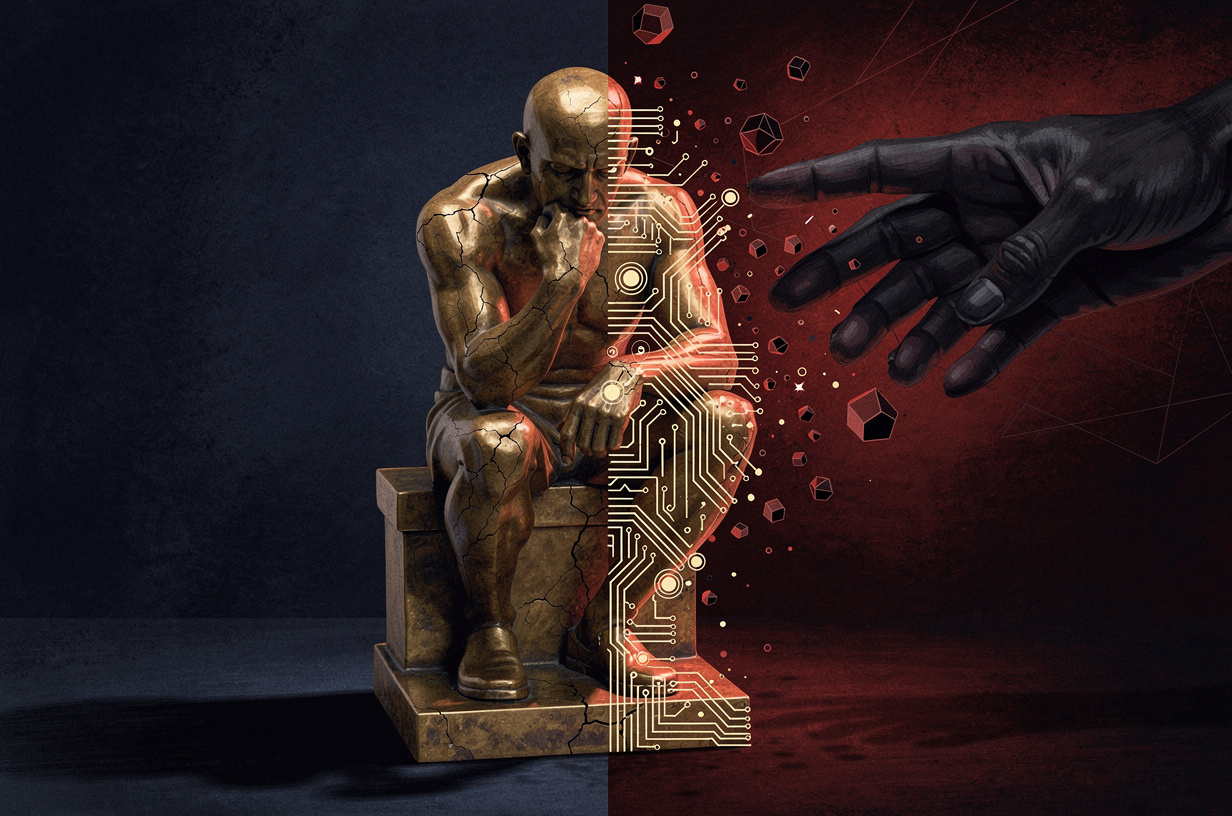
A verdict out of France involving the Rodin Museum and digital artist Cosmo Wenman has landed with significant implications for how museums worldwide treat the 3D scans they commission of public-domain works. Wenman spent years attempting to obtain high-quality 3D scans of Rodin's sculptures — works firmly in the public domain — from museums that had commissioned the scans but were claiming proprietary control over the resulting data. The Rodin Museum in Paris was a central case. The ruling, as Wenman describes it in his Substack, supports public access: faithful three-dimensional reproductions of public-domain works do not generate new copyright for the entity performing the reproduction.
The legal question is whether a museum commissioning a 3D scan acquires copyright over that scan, given the technical skill and decisions about lighting, positioning, and resolution involved. The verdict applies a logic familiar from the US case Bridgeman Art Library v. Corel Corp — which held that faithful photographic reproductions of two-dimensional public-domain artworks lacked sufficient originality for copyright — and extends similar reasoning to three-dimensional reproductions. The 92-comment HN discussion drew legal professionals, museum workers, and digital artists who debated the policy tension: museums bear real costs for digitization, and eliminating any proprietary interest in the results could reduce incentives to undertake it, but the objects themselves are held in trust for the public, and allowing digitization to create new decades-long property rights effectively extends private control over cultural heritage that the public domain was designed to prevent.
A related technical piece by David Buchanan described a vulnerability in the C2PA timestamp mechanism — the Coalition for Content Provenance and Authenticity standard increasingly adopted to distinguish AI-generated from human-created content. The flaw involves how timestamp tokens from trusted certificate authorities can be requested and attached to content in ways that make the chronology of creation misleading. It does not break the entire system but complicates the verifiable 'this content was created at this time' claim that C2PA is designed to establish — a concern that intersects with the Rodin case as museums increasingly consider distributing authenticated digital reproductions with provenance chains.
A piece examining why modern city-building games feel hollow despite technical sophistication drew 134 comments that migrated naturally into software design. The author argues that games like Cities: Skylines 2 optimize for systems complexity at the expense of the human drama that made earlier titles feel alive — a critique the HN community mapped onto software broadly, where measurable-metric optimization can erode intangible qualities that earlier, simpler versions possessed. The counterprogramming arrived in the form of Hole Punch, a browser game in which players sling a spaceship around gravitational fields: one mechanic, made by one person, generating 68 comments of shared strategies and completion times. Grant Sanderson's video essay on mathematics pedagogy — arguing that math is taught in the order it was discovered rather than in the order that makes intuition most accessible — drew similar community energy, with teachers and mathematicians debating how symbol manipulation taught before geometric intuition produces students who can manipulate rules they do not feel.
Ukraine's Accidental Energy Experiment and Games That Endure
Ukraine has become, under duress, the world's most consequential real-world laboratory for distributed energy resilience. A piece from Energy Transition describes how systematic Russian attacks on centralized power infrastructure — large generation plants, substations, long-distance transmission lines — have driven rapid adoption of distributed solar, small wind, and battery storage. The military logic is straightforward: a single large plant can be destroyed with a missile; a thousand rooftop solar installations cannot. Those distributed systems maintained power to communities when the centralized grid failed, demonstrating at national scale and under live adversarial conditions what network theory predicts but academic models cannot fully replicate.
The engineering complexity created by distribution is real: grid management with thousands of small generation sources is dramatically more difficult than managing dozens of large ones. But the argument Ukraine is demonstrating goes beyond economics. Energy infrastructure resilience as a national security asset — infrastructure designed to survive precision strike campaigns — is being watched closely by defense and energy planners in Taiwan, the Baltic states, and other countries facing potential adversaries with similar capabilities. The piece connects back to the electrician shortage discussion: the people who build and maintain distributed energy infrastructure are the skilled tradespeople whose pipeline is under strain.
Jagex's announcement of a new RuneScape MMO — reportedly titled RuneScape 4, with a presence at play.runescape.com/4 — drew 31 comments notable for their cautious optimism. The RuneScape franchise has survived nearly 25 years across multiple iterations, including the striking case of Old School RuneScape, launched as a nostalgia project on 2007-era game design and now reportedly outpacing the modernized version in active player count. That audience actively prefers slow, grindy mechanics and minimal hand-holding — a self-curated resistance to the 'soullessness' that the city-building piece diagnoses in technically sophisticated but emotionally distant games.
A post titled 'Dirty Optimization Secrets' described techniques for extracting performance from the Playdate — a tiny handheld console with a crank — including loop unrolling, careful register allocation, and avoiding standard library functions with hidden overhead. The piece exemplifies the creative problem-solving that extreme hardware constraints reliably produce and illuminates how hardware actually functions in ways that most modern development work obscures. A philosophical essay, 'The Body of Work Thinks Back at You,' argued that accumulated creative output develops its own character that reflects and informs ongoing thinking — a frame that several HN commenters applied directly to the agent memory debate: an agent's body of produced work is itself a form of memory, even without a dedicated memory architecture.